What to Look for When Choosing a Ceiling Lamp?
Ceiling lamps are the most frequently searched for home lighting. Hektor Light offers thousands of options, and we provide advice on what you should know before making your final choice.
- What should you consider when choosing a ceiling light fixture?
When discussing suitability for a room, the fixture's design, color, and style, there should be some connection with other objects in the room, whether it's the color scheme, detail, or form. Usually, when choosing an interior style, you should be guided by the exterior of the building. However, skillfully mixing styles produces a much more interesting result, and what matters most is individuality. Inevitably, styles and trends change; they are related to various technological developments and new innovative possibilities. This results in more efficient, architectural, eye-friendly, and multifunctional light fixtures, which in turn make our lives easier, more comfortable, and healthier.
- How large should a ceiling lamp be?
The fixture size should be proportionate to the room, and with larger fixtures, you must also pay attention to its weight (kg) for safe installation and hanging. However, what is much more important is what kind of light the fixture provides, where it is directed, or what kind of atmosphere you want to create in the room.
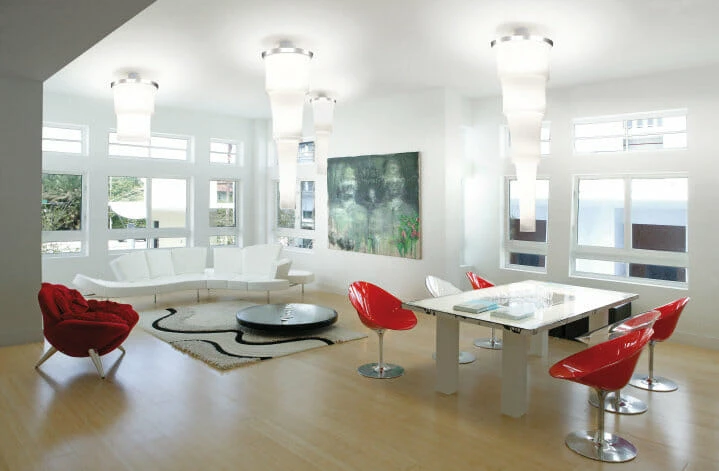
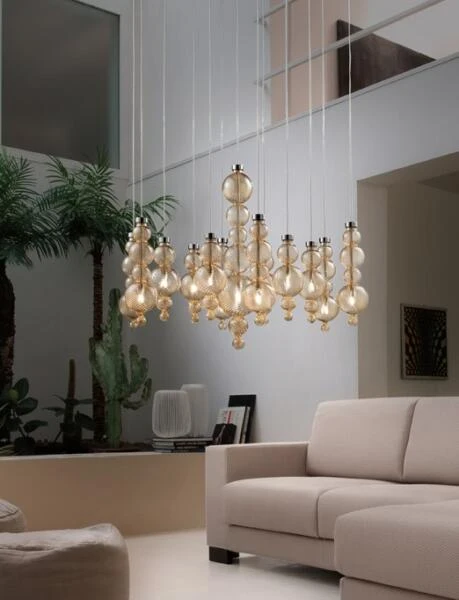
A ceiling light should provide the room with general lighting, ensuring uniform and sufficient illumination for all daily activities. Lanterns and hanging lights allow more room for play in rooms with high ceilings. They should then be more substantial or arranged in groups.
Should ceiling lights be combined with wall or floor lights?
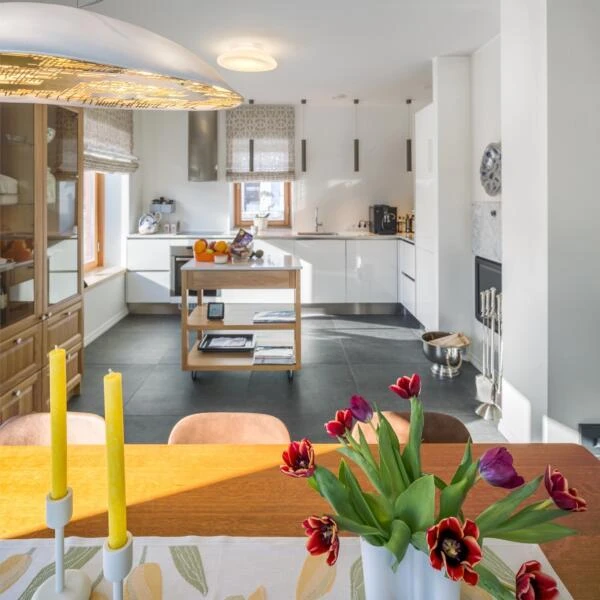
Good lighting should be multifaceted – if you turn off some lights, you can create a different effect with other types of lights. The abundance and variety of light sources provides the opportunity to illuminate different areas of the room.
To achieve this, you should use different types of lights: wall, ceiling, cornice, floor, and/or recessed lights.
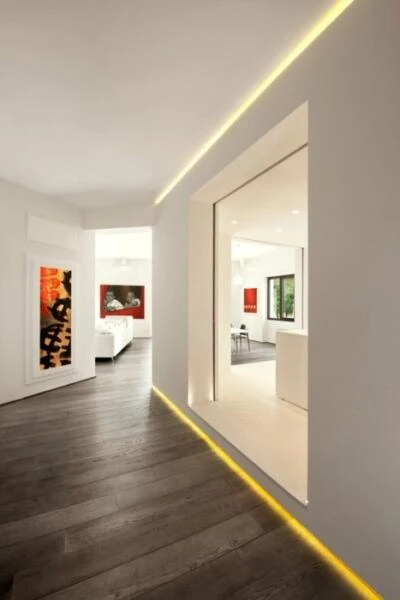
A good solution is hidden lighting, for example, light directed from behind cornices or ledges onto the ceiling or walls. For cornice lighting, you should use an average light flow of 2000 lm/m with a power of 15W or more.
- How high should a ceiling light be hung?
For a room with standard ceiling height, the minimum hanging height of a pendant light from the floor should be more than 2 meters. In a room with more than 4 meters of height, you should find the midpoint between the ceiling and floor (approximately 3m from the floor); at this height, the decorative part of the fixture, the shade, should be located. You should ensure that the fixture remains visually visible from different directions. For multi-story spaces, open shade fixtures with their contents should not be within line of sight. With fixtures installed at the correct height, you can make a living room visually lower and cozier and tie it together with the interior.
Read more about lighting for rooms with high ceilings
- What indicators should you monitor with LEDs? Should you prefer warm or cool light?
Important indicators for LEDs are luminous flux (lm), color temperature (K), and color rendering index (CRI).
Lumen (lm) is the amount of light that a light source can produce. This is the first indicator to follow with a fixture. Different types of bulbs use different power to produce the same luminous flux. The higher the lumen value, the more light the bulb can produce.
Kelvin (K) is the color temperature, or light tone, which expresses the thermal impression associated with color perception. If the color temperature is up to 3300K, the light usually appears warm, but if it's over 5300K, it appears cool. The higher the value, the cooler the light.
What has the most favorable effect on humans is the full spectrum of light, or daylight. The spectrum of daylight is always uniformly full spectrum.
Color Rendering Index (CRI) is a parameter that shows how accurately a light source reproduces the colors of objects. Interior artificial lighting must allow the human eye to perceive colors correctly, that is, as in natural daylight. Without distortion, the color rendering index is Ra=100, which means that all colors are perceived equally well. An acceptable color rendering index is CRI >80.
WATT (W) is the power of the light source, which today does not provide adequate information about the light beam properties. It only shows the efficiency of the fixture, that is, how much power it needs to produce the given light output or electricity consumption per hour.
What budget should you consider when buying a proper ceiling light?
Solutions are very personal and possible with different budgets. We recommend contacting lighting professionals on this topic.
- Why should you think about proper lighting for your home interior?
Lighting ensures visual comfort and visual ability, and it affects our emotions.
Although the best light is natural light, we unfortunately spend a lot of time in artificially lit rooms, but the goal is to create similar eye-friendly light. Ideally, in comprehensive room design solutions, one should consider the human body's circadian rhythm, where morning light is cooler (4000-5000K), work area general lighting has a higher color temperature (4000-6500K), and the evening ends with dimmer yellow light (below 2700K).
- What are the main principles you should follow when creating interior lighting solutions and selecting fixtures?
Ideally, we need personalized lighting for each activity, a lighting solution for each room with different tasks. When planning lighting, you should anticipate these different zones, your furnishings, and your needs.
The general goal is to ensure general lighting first. Unfortunately, too often only ceiling lights are used, which is rather insufficient lighting. However, you must also light the areas of the room that fall outside the light beam of the ceiling fixture.
Therefore, a good solution could be recessed lights distributed throughout the room. These can be recessed where possible, but there are also surface-mounted (if recessing is not possible) or semi-recessed lights.
Meanwhile, accent lights help illuminate oddly shaped rooms or sloped ceilings, where pendant lights are not suitable.
When possible, you could also use directional ceiling, wall, floor, or table lights, as with their help you can illuminate zones, views, pictures, and places that are necessary. Creating coziness is important through the creation of shadows and varied lighting tones.
We also recommend using light dimming and creating separate switching options.
There are fixtures on sale that already have built-in light intensity control functions, which allow you to adjust the light individually or fine-tune it. This changes the light intensity.
It's also worth trying LED bulbs with the same function.
You can also fine-tune the color temperature of the light source itself using current smart applications according to need within a certain range. This type of light color change is called dynamic lighting, where with one and the same fixture, we can create different light colors, in one case a bluish and cool tone, in another case a yellow tone, where the blue spectrum component of the light is small. This way, light can affect our well-being, emotions, and health. More specifically, in yellow light, we feel cozy, comfortable, and lazy, because the sleep hormone has started to act, while in white light we are more alert and mental work functions much better. So we need both kinds of light. In the morning, we should get cool light in the room because we want to wake up quickly and become more work-capable, in the evening when we are preparing to rest and sleep, we should change the light color to warmer again. Thanks to the rapid development of LEDs, this is now possible.
Speaking of different rooms, for example, a child's room, when selecting lights, you should first consider the child's age and what activities are done there most often. In the toddler age, it's worth avoiding fixtures with glass shades, which can easily break during play. General lighting can be created with various and safe-to-break recessed lights. With a limited budget, you might avoid very childish special fixtures, as children quickly outgrow them.
In a bedroom, it's recommended to use flush-mount type fixtures that are closed below, so the light doesn't shine in your eyes while in bed. An ideal solution is to install lights in the headboard area with a switch, so you don't have to get up before falling asleep to turn off the lights. This should already be planned during the design phase, so wires don't remain visible on the wall. When choosing a wall light, you should think about its purpose – whether it should only be mood lighting or reading light, whether it should be a narrowly directed light so it doesn't bother a partner at the same time, or whether it should be a light panel instead.
When selecting a light for the kitchen or dining table, it's worth thinking about how easy they are to clean.
A properly chosen fixture adds warmth and space to a room, doesn't dazzle, and doesn't create annoying reflections or shadows.
An excessively matte shade made from colored glass, fabric, or metal is not efficient, as it suppresses too much light.
For rooms with low ceilings, flush-mount and ceiling-mounted lights are suitable.
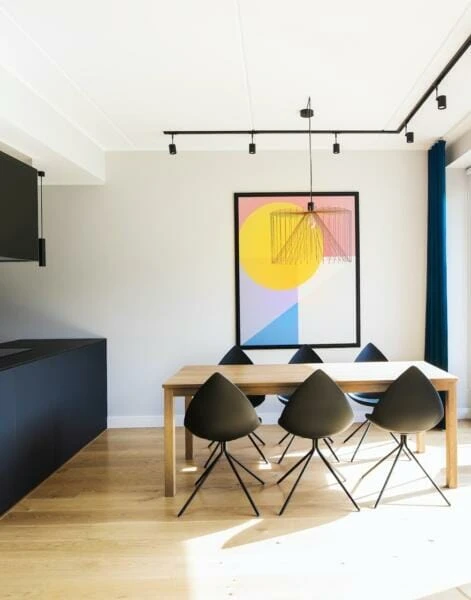
Thanks to the rapid development of LED technology, decorative track lights and various linear lights are gaining popularity, which can ensure room-wide illumination. Modern tracks are small, narrow, and compact, and can be directed by rotating the profile; various directional lights can be placed in them. New solutions include magnetically latched lights that are easy to install yourself and can be repositioned as needed.
- What should you definitely avoid when selecting lights?
You should avoid both over- and under-lighting. Unfortunately, we tend to see more under-lighting in homes.
- Can anyone create appropriate lighting solutions, or should you seek professional help?
It should be noted that if you want good, interesting, and comprehensive lighting, you need to start planning the lighting early, because later in an already fully finished room, it's no longer easy to add, for example, recessed lights into the floor or wall or create a smart home solution for savings and comfort. Therefore, we recommend contacting a specialist who can provide advice and prepare a lighting plan in advance. The choice of design and style is still up to the homeowner themselves, but our customer service representatives are happy to help with that as well.
Above all, it is the preferences and visions of the family members that make a home a home.
Visit www.hektor.ee
Search
Keywords
Most read articles
- Price per Square Meter of Apartments in Tallinn in 2025

- Apartment Market in Early 2026: Prices Rising, Transaction Activity Remains Modest

- Apartment Market in Early 2026: Prices Rise, Transaction Activity Remains Modest
- Estonian Apartment Prices and Market Expectations in 2025
- Notary Fee and State Fee – Who Pays and How Much?