What Natural Stone is Suitable for Paving a Terrace, Stairs, and Footpath? Why Choose Natural Stone?
The use of natural stone in construction and finishing has a significantly smaller environmental footprint than artificially produced sheet and stone materials. Natural stone materials have been used by humans for thousands of years and therefore are very well known, but how well they have withstood various conditions and uses over centuries. But which stones are suitable for outdoor conditions in Estonia?
"Natural paving stones and slabs are more practical than most concrete and artificial stones, but from a very wide selection of natural stones, you need to choose frost-resistant and durable materials. For example, granite with the right thickness and surface treatment is weather-resistant and durable, while marble and limestone usually do not suit paving stones in our climate," says Aivar Allikmaa, founder and owner of Lossikivi OÜ, which has been selling natural stones in Estonia since 1990, and a geologist.
According to him, sandstones have materials with very good weather resistance, but there are also less cemented sandstones that are not recommended for paving. "Porphyries, basalts and other igneous rocks, as well as quartzites, are also suitable for paving. The advantage of natural stone is certainly environmental friendliness, as harmful waste is not generated in the production of these materials and the material is recyclable. A good example is porphyry cube stones, which in Italy are removed from old roads and squares and reinstalled elsewhere. Used cube stones are run through a drum and after drumming they look like new again."
Broadly speaking, paving stones can be divided into:
- Irregular shaped slabs with natural surface.
- Broken, burnt, natural surface or drummed cube stones.
- Chiseled surface paving slabs in various sizes and thicknesses.
- Various edge stones.
Irregular shaped slabs with natural surface can be made from layered stones such as limestone, sandstone, quartzite, porphyry and gneiss. The thickness of these slabs is usually varying, for example 1-2 cm, 1-3 cm, 2-5 cm or 3-6 cm depending on the natural layer thicknesses of the rock. The natural surface of some materials can be quite smooth but not slippery, while the surface of others is more textured or even stepped.
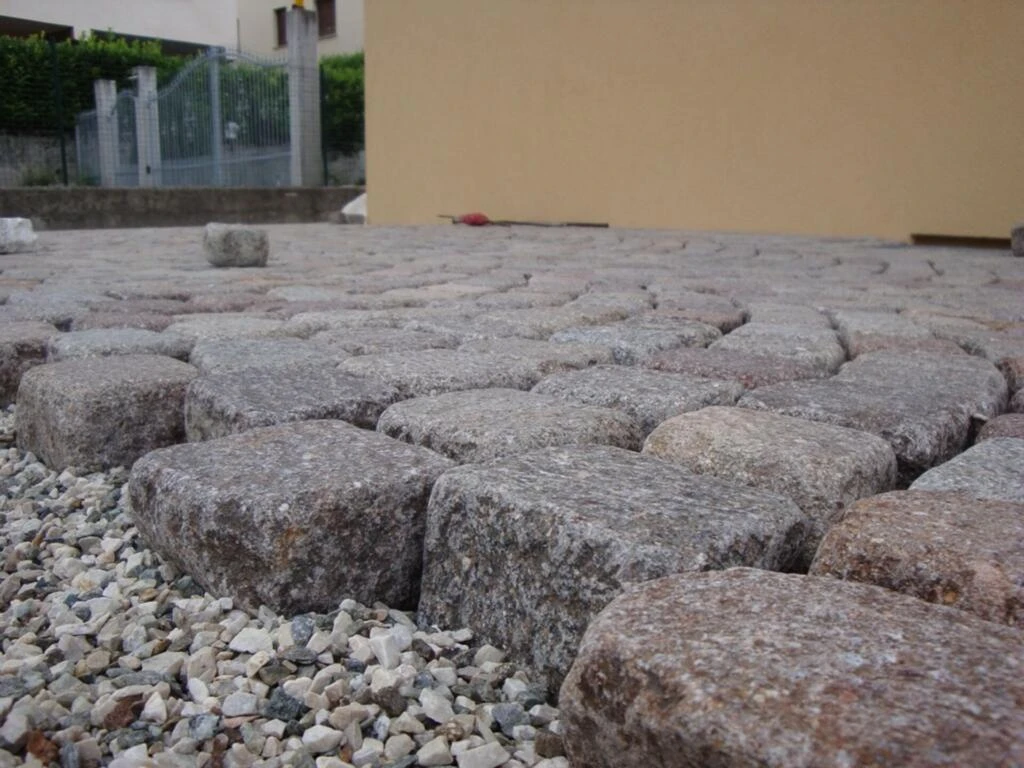
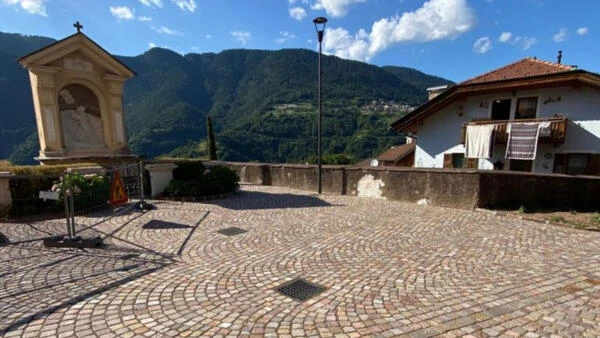
Cube stones are most commonly made from granite, basalt, gabbro, but also from porphyry, sandstone, marble and some limestone. The most common sizes are 5x5x5 cm, 10x10x10 cm, 14x14x14 cm, 10x20x10 cm, 14x20x14 cm, but also thinner thicknesses such as 10x10x5 cm. The tolerances of cube stones made under a guillotine are usually quite large and therefore they are installed more in a fan pattern than in rows. For larger sizes, even larger tolerances must be expected. Cube stones can have, for example, all sides with broken surface or burnt surface on top and the remaining sides broken. Also burnt or hammered surface on top, sawn on the bottom and sides broken, or completely drummed surface, or those that are natural on top and bottom with broken edges. There is something for every taste!
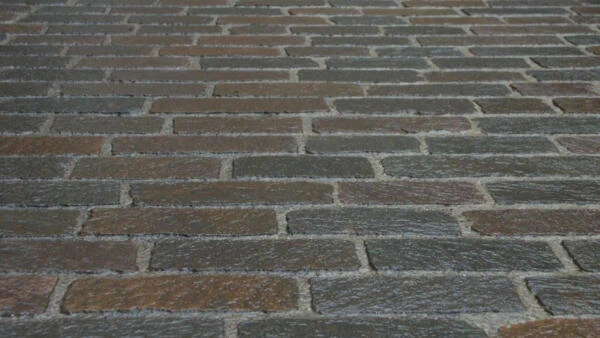
Paving slabs with chiseled surface made of natural stone are available in various sizes and thicknesses, but the most important thing is that they are not slippery and have sufficient strength. On sidewalks where cars do not drive, the slabs can be thinner, but slabs that support heavy machinery must be significantly thicker. The thickness of the slab also depends on its size: the larger the slab size, the greater the thickness should be. It is not recommended to use sharp-cornered slabs, as their corners can break more easily during use.
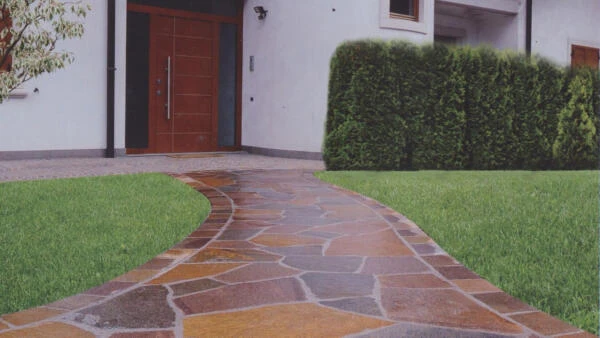
Paving slabs are made from various natural stones, such as:
- Granite (with chiseled surface, mostly gray, yellow or red tones)
- Basalt (with chiseled surface, mostly dark gray and black tones)
- Gabbro (with chiseled surface, mostly dark gray or black tones, sometimes with greenish tints)
- Porphyry (mostly with natural surface)
- Quartzite (mostly with natural surface, mostly lighter tones)
- Sandstone (with natural or chiseled surface, mostly gray, yellow or red tones)
- Limestone (some weather-resistant varieties mostly with natural or chiseled surface)
- Slate or phyllite (some weather-resistant varieties, such as Orivesi black slate)
More common slab sizes are 30×30, 30×60, 40×60, 60×60, 60×90, 60×120 cm and their thickness starts from 2 cm. Paving slabs are installed on a gravel-sand base (thicker and larger slabs) or on a thicker mortar layer (either on damp soil or on a dry sand-cement mixture). For filling joints, a special joint filler should be used, epoxy joint fillers are particularly convenient and durable as they do not require washing later. When using cement-based joint fillers, careful and repeated washing of surfaces is necessary to prevent an ugly and difficult-to-remove thin cement film on the surface.
Peruvian travertine or Inca stone (Inka's marble)
Travertine, with excellent weather resistance and strength, is perfect for paving as well. For five years, Lossikivi has been selling thin finishing slabs, paving stones, mosaic slabs, facade slabs, sinks, etc. from travertine quarried at altitudes of more than 4 km in the Central Andes mountains of Peru. Travertine is a type of limestone that has formed from spring lime in hot springs and/or limestone caves. Extremely hot groundwater dissolves the surrounding limestone and brings it to the surface as geysers, where it turns to stone again. A new deposit, the formed rock – travertine – is full of gas bubbles which, seeking to escape from the deposits, give the rock its characteristic open porosity.
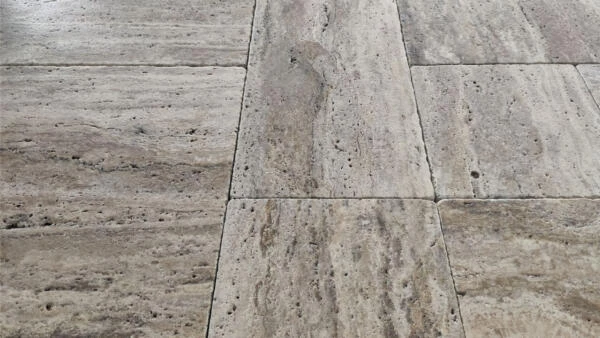
Peruvian Andes travertine has been quarried since 2006 in a place where the ancient Inca culture once reached its peak. Travertine is broken as environmentally friendly as possible and finishing slabs are produced using the best Italian stone processing technology under demanding quality control.
Compared to other travertines on the market, Peruvian stone is denser, with greater flexural strength and lower water absorption. Unlike most limestones, the rock is resistant to salts and has excellent weather resistance, which allows it to be used even in regions with very harsh climatic conditions. For example, thin 10 mm slabs with sizes of 1200×600 and 2400×600 mm are produced from Peruvian travertine, and these slabs have no reinforcement grids. Natural stone slabs of such sizes and so thin are not produced anywhere else in the world.
Lossikivi is the official representative of Peru's largest travertine quarrying and processing company, Minera Deis, in the Baltics and Scandinavia. Allikmaa recommends Peruvian travertine slabs and mosaics in various sizes and thicknesses for both dry and wet rooms in private homes, on walls and floors. Thicker slabs can also be used on outdoor terraces, outdoor kitchen floors and pathways, as travertine has good frost resistance. It is also a very beautiful and practical facade slab.
Lossikivi OÜ, which started out of enthusiasm and love for natural stones, sells quality natural stone materials ranging from floor, wall, terrace and sidewalk slabs, steps and stone paving to stone mosaics and unique natural stone materials. Lossikivi's warehouse contains approximately 13,000 square meters of various materials and about 250-300 different products in the selection.
See: www.lossikivi.ee
Search
Keywords
Most read articles
- Price per Square Meter of Apartments in Tallinn in 2025
- Apartment Market in Early 2026: Prices Rising, Transaction Activity Remains Modest

- Apartment Market in Early 2026: Prices Rise, Transaction Activity Remains Modest
- Estonian Apartment Prices and Market Expectations in 2025

- Notary Fee and State Fee – Who Pays and How Much?