Viljandi City Center Dilapidated Historical Building Being Reconstructed into Apartment Building for 3.5 Million
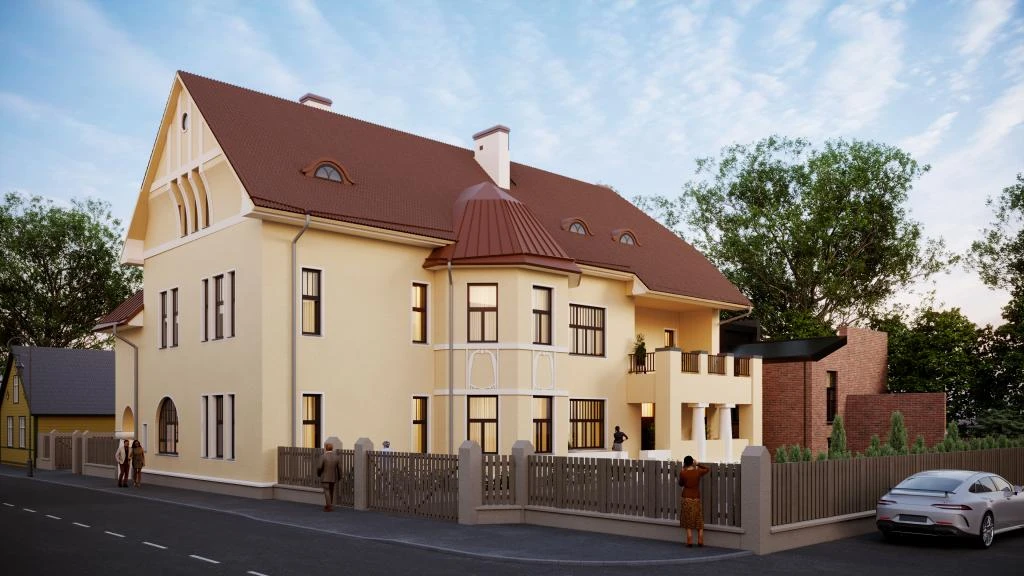
OÜ Luikmulk is investing over 1.3 million euros in the reconstruction of Villa Doll, an architectural monument from the beginning of the previous century located in the center of Viljandi, and the project is also financed by Bigbank with a 2.2 million euro development loan.
“This building caught my eye long ago. Such an interestingly historically and architecturally significant building right next to the main street was simply decaying. It was sad to watch. At one point we decided to restore it,” commented Hardi-Sander Luik, a member of the board of OÜ Luikmulk, and added that although a considerable part of the original finishing has unfortunately been lost, many valuable interior details have been preserved, such as Art Nouveau tiled stoves, Art Nouveau wall paintings, ceiling cornices, glazed window frames, ceramic floor tiles, fragments of stairwell railings, and the like. While most companies dealing with development avoid buildings located in heritage protection areas, according to Hardi-Sander Luik, Luikmulk does not. “We have previous experience in reconstructing objects located in heritage protection areas and with all sorts of restrictions, and therefore we also dared to undertake Villa Doll,” said Luik.
Named after the Baltic German pastor and pedagogue, construction work on Villa Doll began at the end of last year, and the ensemble of buildings consisting of a main building and courtyard buildings with 20 apartments will be completed in spring 2025. The smallest apartment is 22.7 m2 and the largest is 100.6 m2.
According to Aimar Roosalu, head of corporate banking at Bigbank, this is a unique and somewhat awe-inspiring project. “Giving new shine to a beautiful historical building listed in the cultural monuments register is very good news for both the future residents and the entire city of Viljandi. Hats off to the brave entrepreneur whose investment courage helps give new life to a piece of our shared valuable history,” said Roosalu.
According to Karin Lapp, a representative of Lahe Kinnisvara, which handles the sale of apartments, the apartments in Villa Doll are for those who want to enjoy the charm of a historical building and modern conveniences. The apartments are suitable both as homes and as investments, because in a declining real estate market, this type of property retains its value. “We are especially pleased that the developer is a local company with a trustworthy background and buyers can be confident in the quality,” said Lapp. What makes the entire project attractive is the fact that several properties are being developed simultaneously, resulting in a living environment with its own fenced courtyard. According to the Lahe Kinnisvara representative, this is truly a unique development project, and financial support from a lender is very important in a small town. “Reconstructing the highest category architectural monument in a heritage protection area is time and money consuming, but I am absolutely certain that buyers will appreciate the work done. A show apartment will be ready in early July, so we welcome everyone to visit,” said Lapp.
Construction of a villa-style residence on Jakobsoni Street was begun in 1908 for the son of pastor Westrén-Doll, who was active in Moscow, and Villa Doll was completed in the winter of 1909/1910. Precise information about the building's architect is lacking, but references have also been made to Karl Burman, a major figure in national architecture, whose notes mention A. O. Westrén-Doll's house in Viljandi. However, art historian Leo Gens has considered it more likely that the project was completed in one of the offices where the architect worked during that period.
As was characteristic of the era, the villa was designed based on Art Nouveau style directions, placing emphasis on smoothly flowing lines. The central part of the western façade is emphasized by a room niche finished with a Baroque pediment, to which is added a projecting balcony supported by two stylized heavy columns and corner pilasters. The façade is decorated with narrow elongated uniquely shaped and variously grouped windows. The main entrance is supported by a vault-like canopy supported by a corner column with a stylized Ionic capital – a motif we encounter elsewhere in the villa architecture of Viljandi from that period.
Bigbank AS (www.bigbank.ee) is an Estonian capital-based bank focused on loans and deposits for private and business clients, which in addition to operations in Estonia has branches in Finland, Sweden, Latvia, Lithuania and Bulgaria, and which also offers its products as cross-border services in Austria, Germany and the Netherlands. Bigbank's balance sheet total exceeds 2.5 billion euros.
Lahe Kinnisvara is a real estate agency operating in Estonia, which was created 7 years ago by people with 20-30 years of experience in the real estate sector. In Viljandi, the company is managed by one of the founders, Karin Lapp. In addition to Viljandi, offices are also located in Tallinn, Tartu, Pärnu and Võru. Services are provided throughout Estonia (including islands).
Search
Keywords
Most read articles
- Price per Square Meter of Apartments in Tallinn in 2025
- Apartment Market in Early 2026: Prices Rising, Transaction Activity Remains Modest
- Apartment Market in Early 2026: Prices Rise, Transaction Activity Remains Modest
- Estonian Apartment Prices and Market Expectations in 2025
- Notary Fee and State Fee – Who Pays and How Much?