Why Won't the Notary Complete the Transaction for My Grandmother's Shared Toilet That's Now My Bathroom?
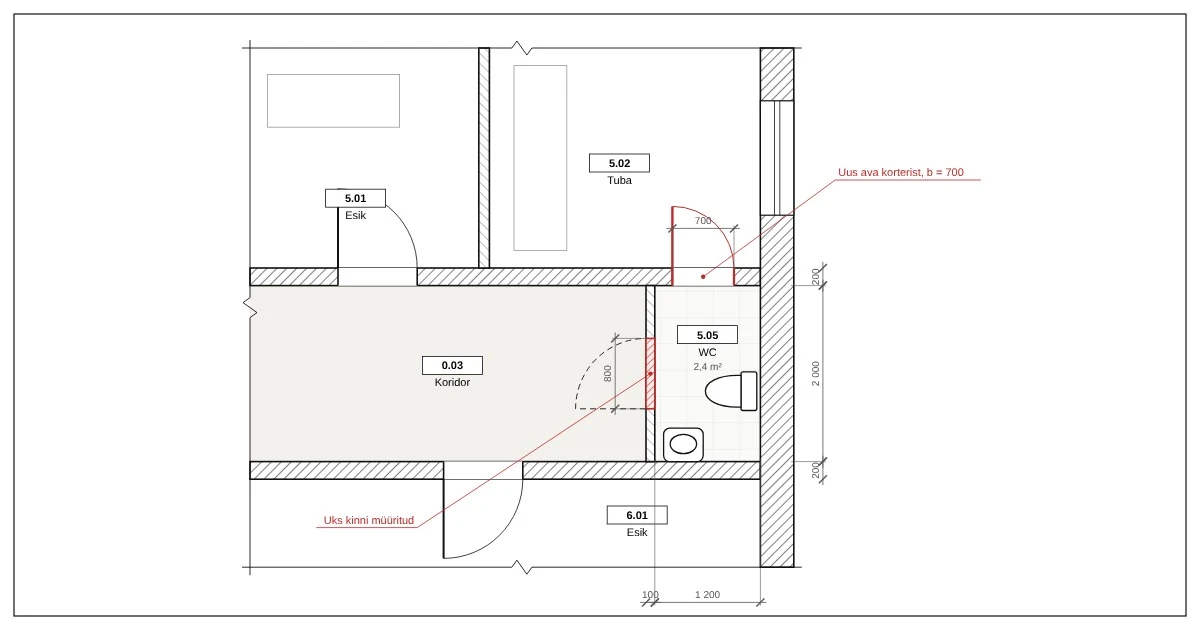
In old apartment buildings, especially those built before 1960, toilet rooms were often shared. One or two WCs in the stairwell or at the end of the corridor for the entire floor. Over time, these rooms have been attached to someone's apartment almost everywhere. The door has been moved to another location, the partition wall has been removed, and water has been brought in. No one remembers anymore who did it and when.
The problem only becomes apparent when the apartment is put up for sale.
In the documents, this room belongs to all owners
If a shared room has ever been attached to an apartment, but this has not been formalized, it still belongs according to the documents to the shared ownership of all apartment owners. The building register shows the apartment's old plan and the land register shows the old area. The buyer's bank sees that the actual area of the apartment and the area in the documents do not match. The notary cannot sell a room that does not belong to the seller.
Recently, I had just such a case in an old five-apartment building. The former shared WCs had already been attached to two apartments in the 2000s, and one had become a proper bathroom. The owner wanted to sell the apartment and wanted to make it easier for the next owner.
What needs to be done
Two things need to be put in order: the building register and ownership.
In the building register, you need the actual plan of the apartment. For this, the apartment and the attached rooms are measured, and new data is submitted to the municipality. If the work was done before 2015 and a room was added with only a water pipe, it may not be an alteration, and notification of data submission may be sufficient. If a load-bearing wall was removed, the matter is more complicated and a building audit may be needed. This can be checked using the building's old drawings, which municipalities usually keep in their archives.
On the ownership side, you need an agreement between apartment owners that changes the boundaries of the apartments (Apartment Ownership and Apartment Association Act § 9). This is concluded at a notary and entered in the land register. If a neighbor does not agree, you can require their consent. The law assumes that the requirement is justified if more than half of the owners, who also own more than half of the shared ownership shares, voted for the change at the general meeting.
One thing that is often overlooked: if the apartment has a bank loan, the bank must also agree to the change (§ 9 subsection 5). It is worth asking about this early, as this may take time at the bank.
Order matters
The most sensible way is to do things in this order: first measurement and building register data, then apartment owner agreement, and finally the notary. The notary needs a plan showing the current and new boundaries of the apartments, and valid register data.
If there are several such apartments in the building, it is worth doing everything at once. Then you need one measurement and one notary visit, and it will be cheaper for everyone.
If your building has something similar and a sale is planned, start with the paperwork before publishing the advertisement. In a simple case, this takes a couple of weeks, but if a neighbor does not agree, it can drag on for months.
This article is general information, not legal advice. Legal basis: Apartment Ownership and Apartment Association Act § 9 (valid wording 15.01.2024), Building Code § 4 subsection 3.
Search
Keywords
Most read articles
- Price per Square Meter of Apartments in Tallinn in 2025

- Apartment Market in Early 2026: Prices Rising, Transaction Activity Remains Modest

- Apartment Market in Early 2026: Prices Rise, Transaction Activity Remains Modest
- Estonian Apartment Prices and Market Expectations in 2025

- Notary Fee and State Fee – Who Pays and How Much?