Today the Office Competes with Home Comfort
Commercial real estate has reached a point where office space and price alone no longer appeal to companies, and the value of an office is instead shaped by its surroundings, says Sten Pärnits, chairman of the board of Mainor Ülemiste, which is developing Ülemiste City.
While ten years ago a company would choose office premises based on the price per square meter and location, according to Pärnits, today companies ask about neighbors, amenities and environment before signing a lease agreement.
Entrepreneurs are looking for an environment that creates value
Around the world, people are being called back to office work, and an employee who has grown accustomed to working from home will only return if the office and everything that comes with it is attractive enough. This is also confirmed by the Workforce Preference Barometer survey, which surveyed 8,700 office workers in 31 countries. The results clearly showed that employees have accepted the requirement to come to the office, but how positively they view it depends directly on the quality of the office experience. Those who are satisfied with their workplace have a positive attitude towards the obligation to come to the office. But those who are not satisfied don't want to come to the office either.
As the location of the office and the environment there become increasingly important arguments for employees, this means that developers need to pay more and more attention to the office surroundings. Change is already visible everywhere in the world, as demand is concentrating in those business districts where all conveniences are within reach. Ülemiste City has been developed as an attractive environment for talent from its early days, which is why the urban complex already has much of what others are only talking about.
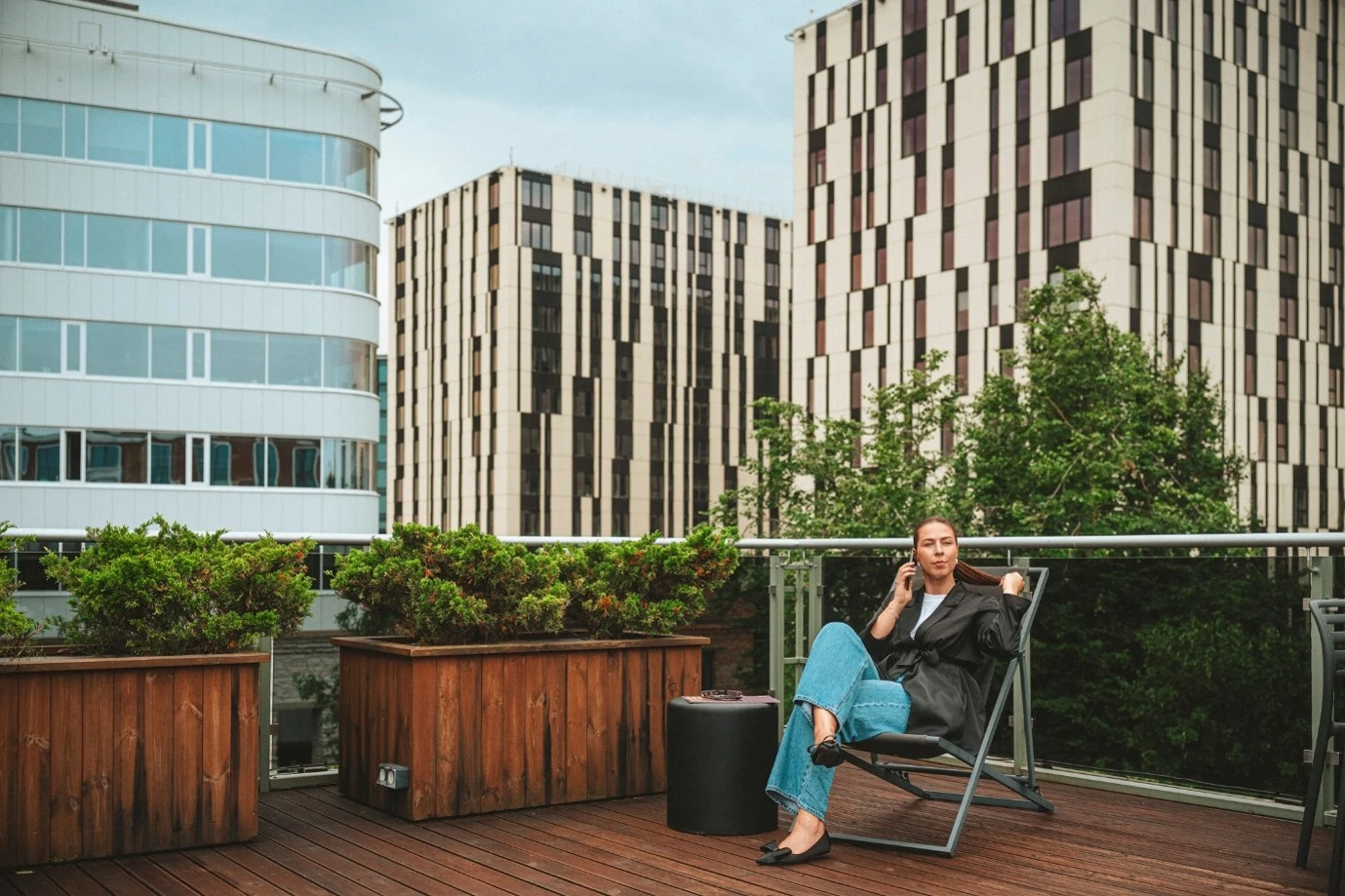
Ülemiste City has several outdoor work areas, attractions designed for rest and movement breaks, and even a path designed for walking meetings.
"An office must provide an experience that you cannot get from home. If it doesn't offer that, then employees won't come and the office will stand empty," explains Pärnits. For companies, this means that the office is no longer just a cost line, but also an important argument in the recruitment process and in retaining employees.
Why have a community in a business district?
"Companies no longer want just an office, they want a network. To have another company next door to collaborate with, a third one that can help hire people, a school that provides the next generation of talent, and services that make an employee's day run smoothly," explains Pärnits.
According to the same philosophy, Ülemiste City and all the business buildings being erected there are being developed. The city complex has a very good automated management service, cleaning service, opportunities to collaborate with other companies, a community fund that helps create a better environment. The result is a deliberately developed environment where people can develop, grow their professional network, achieve more, and take rest and movement breaks to continue working even more productively.
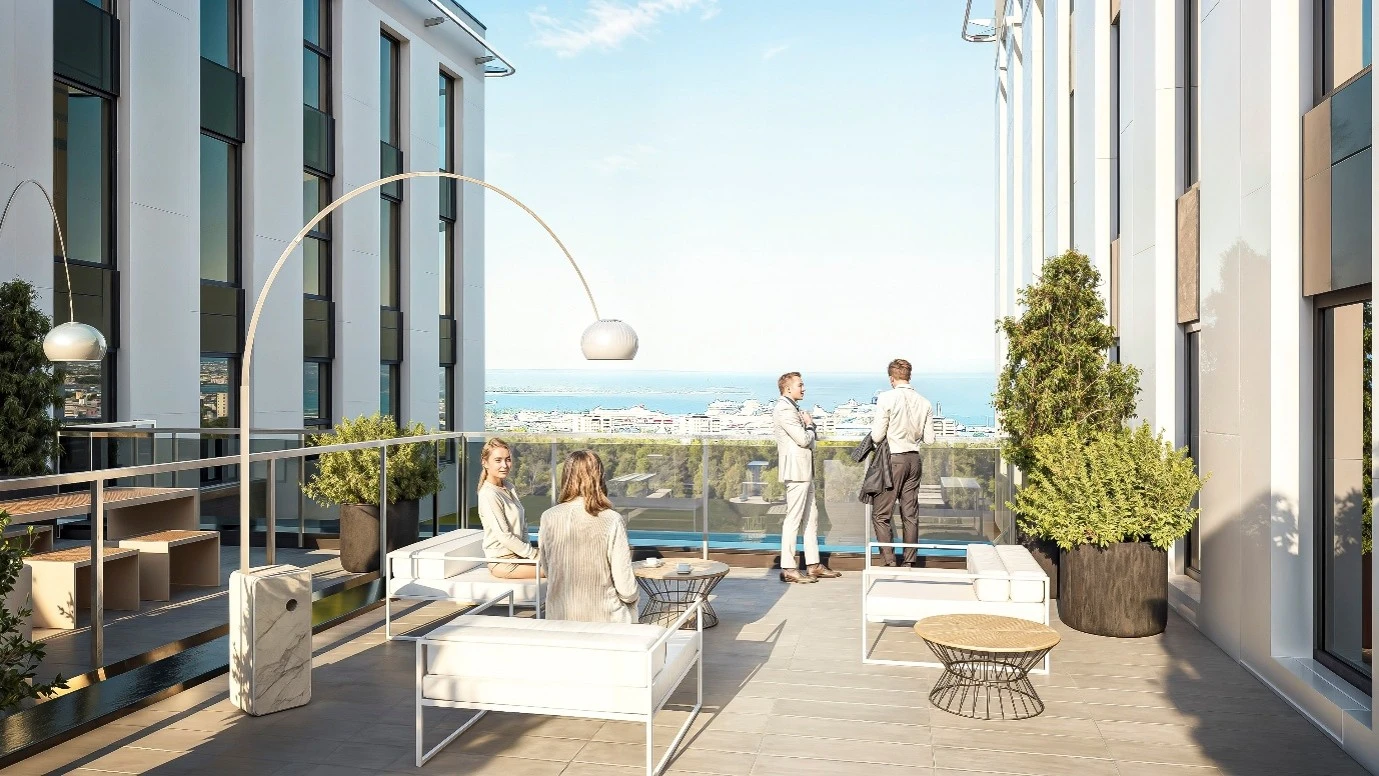
Photo: A terrace with a sea view is planned between the towers of Masingu House.
"About 400 companies operate in Ülemiste City, where approximately 18,000 people live and work from 73 nationalities. The annual turnover of companies exceeds 2.5 billion euros. Based on payroll taxes, we are the third largest economic environment in Estonia after Tallinn and Tartu," says Pärnits. Equally important for the city complex is how companies grow there. Statistics show that the added value created by companies located in Ülemiste City has grown faster over the years than the average in Estonia. According to him, the added value per employee of large companies is about twice as high as elsewhere in Estonia.
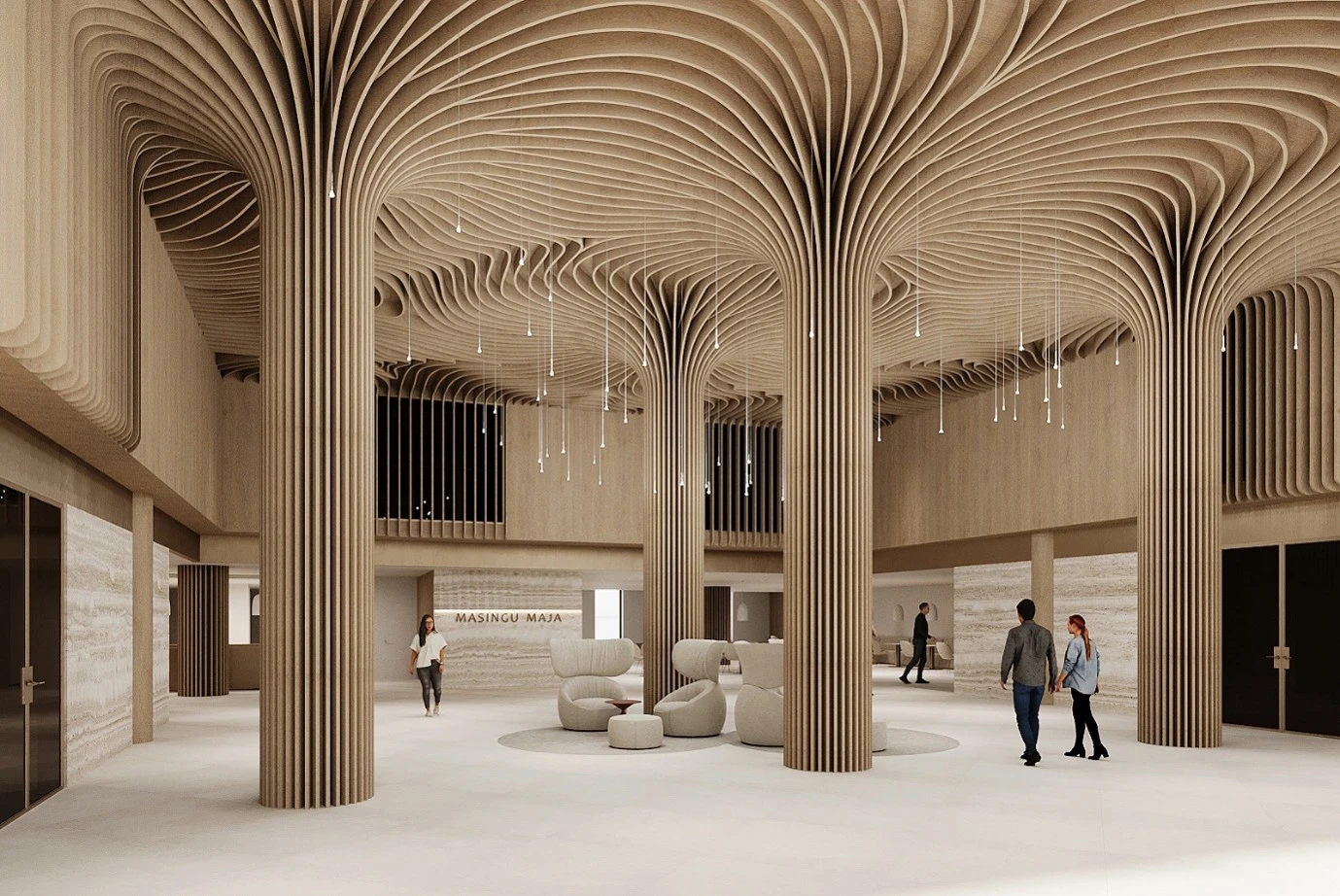
In 2027, the city complex's newest business building, Viktor Masingu House, will be completed. "For us, this is a new opportunity in an already functioning ecosystem. We have taken into account that companies moving here are not simply moving into a new building, but are also gaining a supportive network where partners, talent and services are within reach," explains Pärnits the principle of the city's developments.
With Masingu House's 20,000 square meters of office space, the emphasis is primarily on flexible solutions that would help, for example, growing companies expand smoothly. Since offices are available in sizes ranging from 180–1,800 square meters, growth is easy. A larger company also has the opportunity to plan a more efficient and functional space solution while being located on a single floor.
"With Masingu House, we have also thought about making common areas spacious, encouraging both spontaneous and planned meetings, which in turn would give momentum to new ideas, cooperation and synergy between companies and people. When people start really communicating with each other again, everyone benefits," says Pärnits.
More information about Masingu House can be found on the Ülemiste City website.
Search
Keywords
Most read articles
- Price per Square Meter of Apartments in Tallinn in 2025
- Apartment Market in Early 2026: Prices Rising, Transaction Activity Remains Modest

- Apartment Market in Early 2026: Prices Rise, Transaction Activity Remains Modest
- Estonian Apartment Prices and Market Expectations in 2025
- Notary Fee and State Fee – Who Pays and How Much?