There Were Tears, There Was Laughter. Our Journey Back Home
How can you actually buy a nice apartment in a new development with a minimal down payment? What are the risks and opportunities when taking out a loan with a partner? What preliminary work does home search and selection require? Pille-Riin (25) answered these questions, and based on her recent experience, she knows the answers to all of these questions.
The idea to get a home came suddenly. My partner Andrus and I were living in a small apartment in Annelinn at that time, but thinking about the future (we need to get a child to school and they need their own room with a desk), we made the decision to buy our own home. With renting, there's always the problem that you're paying money to someone else and getting shelter for an indefinite period. A home loan, however, costs about the same as rent and the property you're buying remains yours (not to mention the opportunity to design your home exactly according to your wishes). In your own home, you do things for yourself and don't have to directly ask anyone for permission on what and how you can do things. There's such a nice feeling of freedom. And in hindsight, it's also nice to look back when something has turned out well – then it's pleasant to recall that it was done according to your own ideas.
The decision to buy a home together
Since I wouldn't have been able to get a loan on my own for the necessary amount (I would have had to settle for something worse, a years-old apartment), the option left on the table was to take out a loan with my partner together. The desire was still to buy a new apartment, which has fewer risks. To be honest, there are always certain risks when taking out a loan together. But today everything is regulated by all sorts of laws and acts, so in that regard my mind is at ease – even in worse cases, everything can be divided equally. Hopefully, things will never go that far. We believe that you should live in the present day, not think about potential negative scenarios.
With your own home, there are many more possibilities than with a rental apartment, because the real estate belongs to you (100% after paying off the bank loan, of course) and as mentioned above, you can do whatever you want with it. If the desire to buy a new home comes up, you can sell the old one and buy a new one or rent the old one out entirely.
Selection criteria
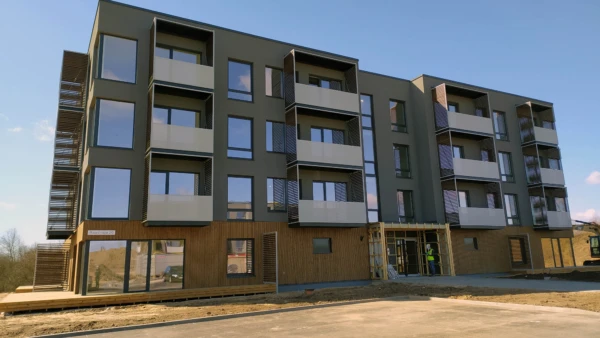
The price was shaped based on a loan calculator. We looked at our monthly incomes and set a threshold we wouldn't exceed. In terms of size, we had a clear understanding that it had to be a 3-room apartment and approximately 60 square meters, and we also wanted either a terrace or a large balcony (not that small Annelinn one anymore). Initially, we wanted a terrace option, but since it turned out that this particular apartment was intended for commercial use, we didn't want to plunge into that tedious bureaucracy – especially since we're still young and inexperienced. In the end, we settled on an apartment with a balcony and we can't complain, we're very satisfied. There's no view from a terrace like from a fourth-floor balcony.
The location is officially outside the city, but still right at the city's edge, which in Tartu terms is not far from the city center at all. Currently, this area is still relatively sparsely populated and feels like living (halfway) in the countryside – a bit away from city noise and hustle.
Home search and selection
But we embarked on different real estate portals and good old Google. We were open in the sense that the apartment didn't have to be brand new. We would have settled for a second-hand market apartment (roughly 2–5 years old, which is basically still new). But since at that particular time we couldn't get suitable second-hand market apartments that would work for us, we stayed with the new development. We considered all sorts of options, both in Ihastes and near the South Center. In the end, however, Raadi caught our eye and its offerings.
An important part of the search process was also the Excel spreadsheets we created, where we carefully started marking our monthly incomes and expenses and the pros and cons of apartments we came across. By now, these spreadsheets have become a kind of family budget. We still keep an eye on income and expenses, and we've also marked all apartment-related costs on a separate sheet. Keeping such spreadsheets is certainly a great help, especially for young home buyers. You can also monitor your financial flows with various apps or in your bank's self-service, but we like good old Excel. It's a matter of taste, as they say.

Down payment
Since the decision to buy our own home came relatively spontaneously, we had a round zero in down payment funds. Well, nothing to be done about it, we researched different options both on the internet and from banks. A great help was a face-to-face loan consultation offered by one bank. I would say that you can get things done virtually too, but nothing replaces real interaction with a person. We knew that surely we'd somehow scrape together some amount for a down payment. Initially, we considered KredEx's guarantee, but there were certain restrictions and paperwork associated with it, and eventually that option also fell off the table. In our case, having an additional collateral was enough, which is my mother's apartment. For that, we had to order a separate appraisal, set up a mortgage, and insure the apartment, but considering the final goal, these costs weren't that large. We just had to take them into account.
Responses from banks
Communication with banks was very prompt and it was also nice that they didn't look at us with contempt because we're so young. They were happy to answer the questions that came up, no matter how silly they were. The unfortunate thing was that out of three banks, we got a negative response from two. We do belong to a so-called risk group (lack of own financing, monthly financial incomes are borderline). With monthly incomes, they also checked whether there were dependents (children). So if you're three people with a child, then all income automatically has to be divided by three. The bank that eventually gave us a loan did so on the condition that we take it out over 25 years (the initial plan was 30 years). We also managed to save up a small amount of our own financing, largely with family support.
As for incomes, banks look very carefully at your payment behavior, in our case over the last six months. So it's worth keeping your finances in order and not going to places that look suspicious in the bank's eyes (like casinos, nightclubs, etc.). You should also pay off installment purchases or minimize them where possible, and you shouldn't use a credit card recklessly. Also, you must complete the probation period at your job before a loan is even considered. In our case, for example, they wanted us to be at our current jobs for at least six months, but in general this limit is at four months (banks and conditions vary). In short, keep your payment behavior in order and then you'll have a chance to get a loan!
Waiting for the new home
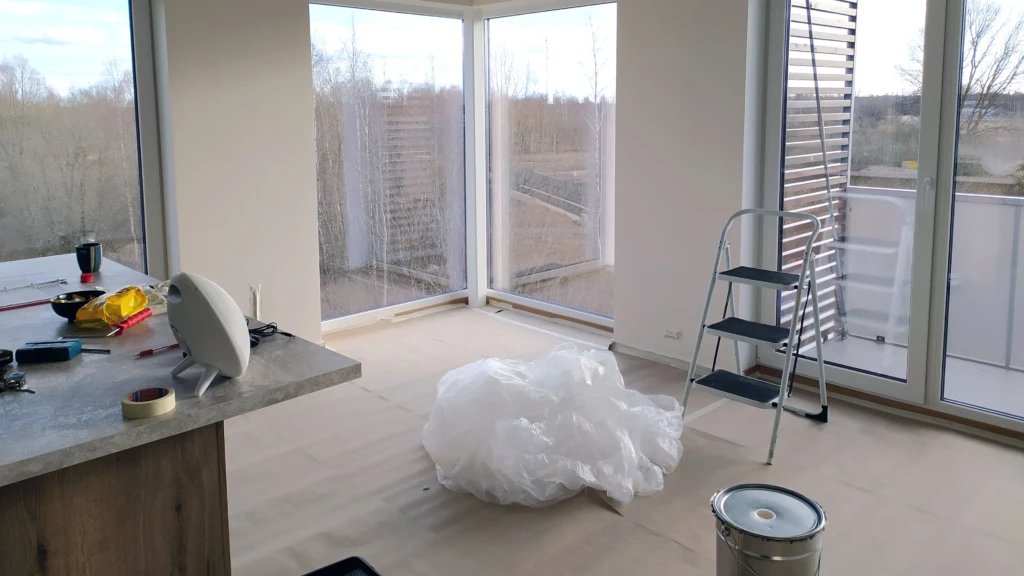
Since I was still a student at the time, we had the opportunity to move into a dormitory. It was a conscious decision so that we could manage for a year and save a lot of money as a result. Well, living in the dorm was its own ordeal, especially since the expectation of getting our own home was great. But we managed. We drove past the construction site several times and the excitement kept growing. We didn't think much about furnishings before getting the apartment, because one thing is having the apartment plan on paper, but another thing is reality.
What we did think about before taking the loan offer, however, was the kitchen furniture. Our special feature was that we wanted the kitchen to be in the apartment when we arrived and to be included in the apartment price (i.e., in the loan amount). It seemed simpler to pay for the kitchen with the same loan than to take out a separate installment payment for it. Plus all that interest business... In short, we found that this way it would be more reasonable and cheaper in the end.
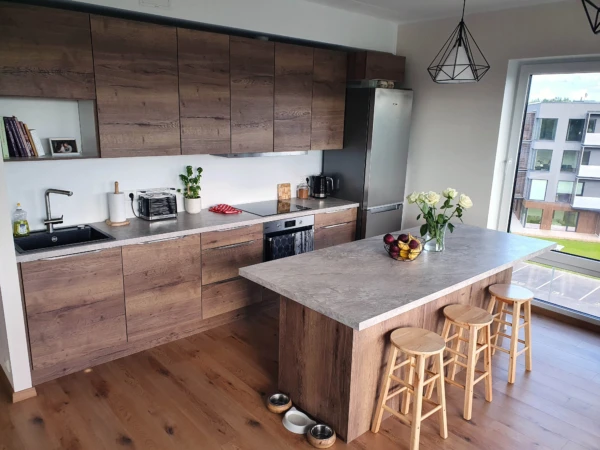
So through a broker, we made an agreement with the developer that the developer gets brokerage from the kitchen, which considering the total cost of the kitchen wasn't very catastrophic, and suggests suitable cooperation partners for us. We had to communicate with the kitchen salon ourselves to achieve the most suitable solution. In any case, the final result was exactly what we imagined and even better. You can buy cheap kitchen furniture from somewhere, but since our kitchen is connected to the living room and we spend a lot of time there (including cooking a lot), the quality and aesthetic appearance of the kitchen is extremely important. So we don't regret the decision.
Positive about waiting was that we got a little breathing room to save money. On one hand, living in a dormitory helped with this, on the other hand, a more economical lifestyle. For example, we allocated a specific amount per month for groceries and also practiced making weekly menus (okay, sometimes we gave in on this, but then the costs started rising right away – mystery!). By the time we received the keys to our own home, we had saved up quite a respectable amount for furnishing the apartment.
Getting along with the broker, developer, and site manager
Since we knew that there was quite great demand for these apartments, we didn't start haggling over the price. We simply didn't come to it at that time, because the apartment was actually quite affordable anyway and most of the energy went into getting a loan from the bank. But the fact that we didn't haggle doesn't mean others shouldn't – I absolutely recommend haggling!
Communication with the broker, developer, and site manager went very well. Answers to our questions were professional and when there were concerns, they tried to accommodate us. All agreements held and promises were kept, so there's nothing to complain about. Getting the keys, there were some problem areas or issues, but they were resolved very quickly.
In hindsight, I remember one funny incident that well illustrates how all communication was working. Namely, we wanted to get a second sink in the bathroom instead of the one we initially had (in the initial case we would have had to buy special order furniture, which in the end would have been more expensive). But seeing how much trouble we had to go through to get the old sink off the wall. We had already unscrewed the bolts, but the sink just wouldn't come off the wall at all. We then called the site manager to get information about who and how the sink was attached to the wall (it was filled thick with silicone from behind). He directed us to the construction worker, who came with his assistant to pry it loose (unfortunately along with the bathroom tile, since there was simply no other option). Luckily, they were so accommodating to us that we got a new tile completely free (we only paid a little for its installation, because we simply didn't have the time to deal with it). All's well that ends well, as you'd say about it. Communication flowed and the work got done.
It's not as hard as it seems
Putting the whole process together: there were tears, there was laughter. Well, all of this should be one big jumble of emotions. But we came out of it alive! We're very satisfied with the home, even though some things don't meet exactly 100% of expectations. We knew from the beginning that the photos visible on the website are illustrative and the descriptions are also embellished (after all, sales is sales and marketing is marketing), so there weren't any major disappointments. The apartment did seem much smaller at first sight than what we could read from the photos and plans, but here I emphasize proper space planning. If you always place furniture and other elements well, it's possible to create additional space.
Three golden words: ask, plan, execute. Because the mouth that asks doesn't get hit, and careful (financial) planning helps you get closer to your goal. And what's yours is yours, that's the nicest part of it.
Article source: Kaanon Real Estate Office
Search
Keywords
Most read articles
- Price per Square Meter of Apartments in Tallinn in 2025

- Apartment Market in Early 2026: Prices Rising, Transaction Activity Remains Modest
- Apartment Market in Early 2026: Prices Rise, Transaction Activity Remains Modest
- Estonian Apartment Prices and Market Expectations in 2025
- Notary Fee and State Fee – Who Pays and How Much?