The Last Heritage Object of the Paper Factory at Katlamaja Will Be Renovated

In Fahle Park, Tallinn's fastest-growing business district, reconstruction work has begun on the Boiler House, the last historical monument of the former cellulose factory, with construction starting at the end of the year. The Boiler House with its chimney is one of the most fascinating memories of the former paper mill, which will become a symbolic center of the area and an important landmark and attraction point in Tallinn. Namely, the Boiler House chimney will be transformed into Tallinn's new viewing tower, and the interior of the Boiler House will create some of the city's most distinctive business and office spaces. Fausto Capital is investing 24 million euros in the Boiler House renovation.
Fahle Park developer Fausto Capital selected the architectural bureau Lumia to design the monument's reconstruction, whose architects have also brought to life the rest of the cellulose factory's heritage-protected buildings and helped make it one of Tallinn's new pearls.
„After the completion of the Boiler House, we will be able to declare the cellulose factory area renovated and move forward with integrating new buildings into the business quarter. This represents a significant contribution by Fausto Capital to preserving architectural heritage and supporting sustainable development of Tallinn's urban space," said Lumia architect Margit Aule.
The heart of the Boiler House will feature a space that rises through multiple floors, and around it will be specially separated business and office spaces with intermediate ceilings. From the Boiler House, a direct passage will lead into the chimney's interior, where plans include building a spiral staircase with a glass lift, leading directly to the top of the chimney. At the tip of the chimney, a glass dome with a terrace will be constructed, offering magnificent views.
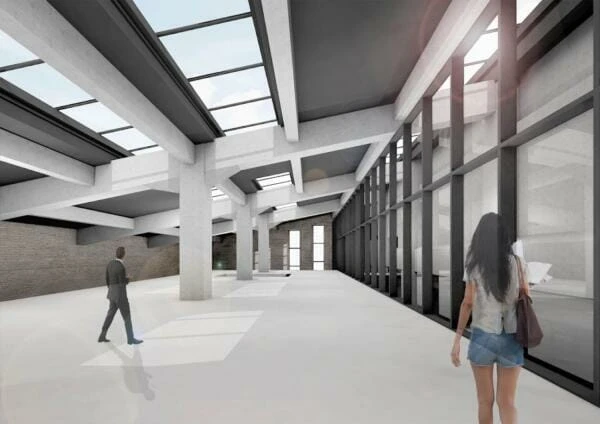
According to Margit Aule, in addition to the boiler, the 6000 m² Boiler House has preserved technological equipment and passages that give the space a unique industrial-historical appearance. „The Boiler House was built in 1922, and there was a mill in this place as far back as the 13th century. The Härjapea River once flowed beside the Boiler House, which is located on the edge of North Estonian limestone, and through it water was supplied to both the Old Town and Kadriorg," Aule introduces the building's fascinating history.
The Boiler House is located in the middle of Fahle Park, which has been renovated into a modern business quarter with complete urban space, and has entrances open in all directions, attracting people from all of Fahle Park and beyond. Across the street remains the glass-roofed, year-round warm and green Fahle Gallery Street, where you can dine on the terraces of cafes and restaurants. Soon to be connected to the Boiler House is a 500-space parking and office building. In the Fahle business quarter, Postimees and Duo Media, Apollo Group, Estonian Unemployment Insurance Fund Career Center, Finest Media, Workland, Argentina restaurant and many others have established themselves.
The public has also noticed the area's transformation, and Fahle Park's second landmark – the gallery street with exotic landscaping – received the Cultural Capital annual award in the "old made new" category this February.
Search
Keywords
Most read articles
- Price per Square Meter of Apartments in Tallinn in 2025
- Apartment Market in Early 2026: Prices Rising, Transaction Activity Remains Modest

- Apartment Market in Early 2026: Prices Rise, Transaction Activity Remains Modest
- Estonian Apartment Prices and Market Expectations in 2025
- Notary Fee and State Fee – Who Pays and How Much?