Tallinn Branch Study Building on Kaarli Avenue at University of Tartu Gets a New Look
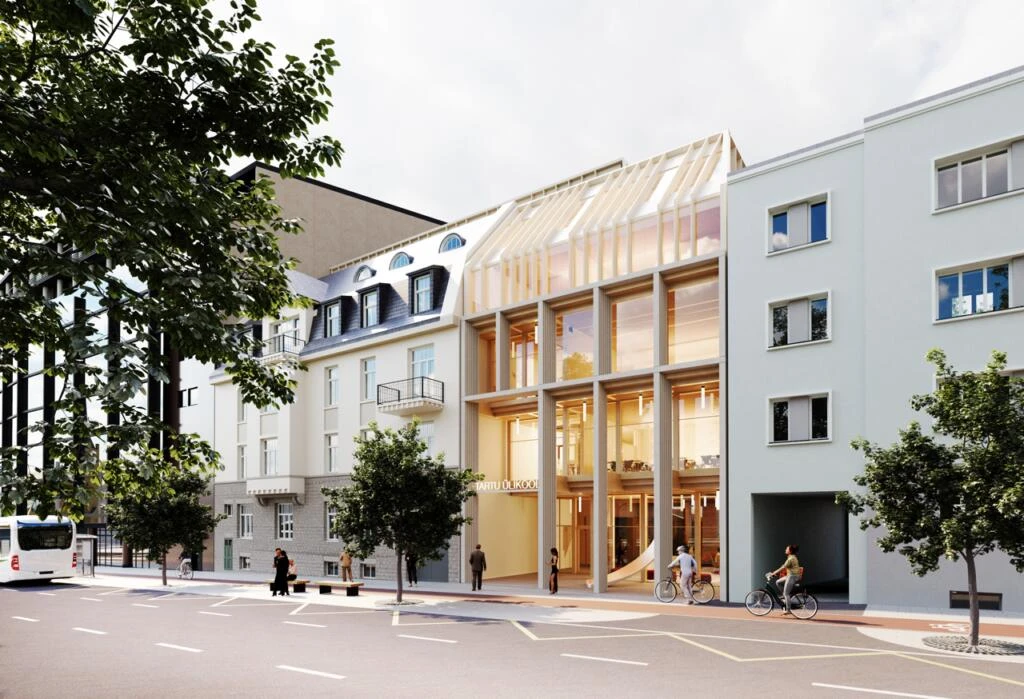
An architecture competition organized in cooperation with the University of Tartu and the Estonian Architects Association determined the best conceptual solution for the reconstruction of the School of Law's Tallinn division's study building and the design of the courtyard area. The competition was won by the concept "Cascade" by Kauss Architecture OÜ.
The goal of reconstructing the Tallinn division's study building is to create a new learning environment for students and faculty, where in addition to lectures, active extracurricular communication and study work also take place. The new spatial solution offers both lecture halls and diverse educational and social areas that promote teamwork and interaction among students.
According to Tartu University Chancellor and jury chair Kristina Noormets, it was a complex task. "On one hand, the location is very important – we had to think about how to present the University of Tartu prominently next to Freedom Square, in a way that would contribute something to the urban space and show respect for the existing environment. On the other hand, it was necessary to maintain a balance in the historical setting between the volume of the old and new building. The additions proposed in the competition entries received a lot of attention from the jury and some entries had conflicting opinions – what should actually be the facade of a university building?" said Noormets.
The jury selected the concept "Cascade" by the architecture firm Kauss Architecture as the best, because its architectural idea is clear, the solution is balanced, and it fits well with the volume of existing buildings. The main facade is representative and worthy of a university.
According to the concept, columns will be constructed in front of the study building's entrance using an airy wooden structure, which help create a practical and large dispersal area in front of the building, meaning the building entrance steps back, so to speak, from the street space. The multi-level and varied outdoor space created on the sunny courtyard is suitable for resting, working, and studying. As a clever approach, the roof of the substation has been put to use, which is connected to the second floor by a bridge, segmenting the space and creating shelter for bicycles as well. The outdoor area is large and versatile – it is a good welcoming courtyard solution.
The building has been given a clear-lined and transparent heart with spacious common areas that functions as a connecting social space. It can be assumed that students will actively use this soft-surfaced stairway area. The foyer is well-designed and its overall impression is open and bright. The spaces are logically segmented and clearly visible to those moving between floors.
A varied common area and social space have been planned, as well as many study nooks, including separable group work areas. The library area is very well connected to the common area and different floors, and the building offers diverse opportunities for working and reading. The wood used in the interior design creates a friendly and pleasant atmosphere, and overall, the spatial solution leaves an impression of being modern, convenient for studying, and inviting.
Sixteen concept proposals were submitted by the deadline for the architecture competition, all of which were evaluated. The prize fund totaled 35,000 euros and was distributed as follows:
First place prize 11,000 euros – competition entry "Cascade" (authors Kristiina Aasvee, Lauri Eltermaa and Kaur Talpsep from Kauss Architecture OÜ),
Second place prize 9,000 euros – competition entry "L and L" (authors Alvin Järving, Ott Alver, Mari Rass, Patrick Barbo, Lill Volmer, Luisa Männilaan and Lukas Laubre from Architect Must OÜ),
Third place prize 7,000 euros – competition entry "Open Space Idea" (authors Keiu Tulev, Anna Solts, Ervin Golvih,
Allar Esko, Jaan Kuusemets and Erko Luhaaru from DAGOpen OÜ architecture office);
encouragement prize 4,000 euros – competition entry "Tabula Rasa" (author Villem Tomiste from Studio Tallinn OÜ),
encouragement prize 4,000 euros – competition entry "Arrow" (authors Lembit-Kaur Stöör, Liis Lindvere, Martin Tago, Raivo Kotov and Vincent Marquardt from KOKO architects OÜ).
The jury that evaluated the competition entries included University of Tartu Chancellor Kristina Noormets, School of Law Director Gaabriel Tavits, head of the development department of the university's real estate section Viljo Vider, representatives of the Estonian Architects Association architects Katrin Koov, Eve Komp and Ülo Peil, and Tallinn City Planning Office architect Lea Järve.
Search
Keywords
Most read articles
- Price per Square Meter of Apartments in Tallinn in 2025
- Apartment Market in Early 2026: Prices Rising, Transaction Activity Remains Modest

- Apartment Market in Early 2026: Prices Rise, Transaction Activity Remains Modest
- Estonian Apartment Prices and Market Expectations in 2025
- Notary Fee and State Fee – Who Pays and How Much?