The Nominees for the Estonian Architects Association Annual Awards 2024 Have Been Announced
The Estonian Union of Architects received a total of 51 projects this year in two categories for its annual awards: 31 for the Architect's Award and 25 for the SMALL award. The jury has selected nine nominees in total, and the award winners will be announced at a ceremonial architecture awards ceremony on January 23, 2025. Additionally, the union will present a student award.
The best SMALL projects were selected by a jury consisting of architects Marika Lõoke, Merilin Kaup and Jaan Tiidemann, landscape architect Juhan Teppart and artist Edith Karlson.
According to Marika Lõoke, the keyword linking the projects nominated for the SMALL award is "for a happier community," and the works submitted to the competition are further proof of the claim that square meters do not determine the impact of architecture. "It was a pleasure to experience that all objects were characterized by environmental sensitivity and site-specificity," said Marika Lõoke.
For the Architect's Award, the selection was made by German architects Arno Brandlhuber and Jonas Janke from the b+ office.
"In the age of climate change and resource scarcity, the construction sector must also rethink itself and find contemporary solutions. We selected four projects as nominees for the Architect's Award, which address the key questions of our time in different ways: what we do with our existing building stock and how we valorize grey energy, how we reduce the use of new materials, raise awareness of the value of seemingly unusable and 'ugly' architecture, how we support local craftsmanship and the use of local materials, and how we preserve the history embedded in buildings," said Arno Brandlhuber, confirming that from this perspective and keeping these values in mind, they looked at and evaluated the nominees submitted to the Estonian Union of Architects' award.
Nominees for the Estonian Union of Architects' Architect's Award 2024:
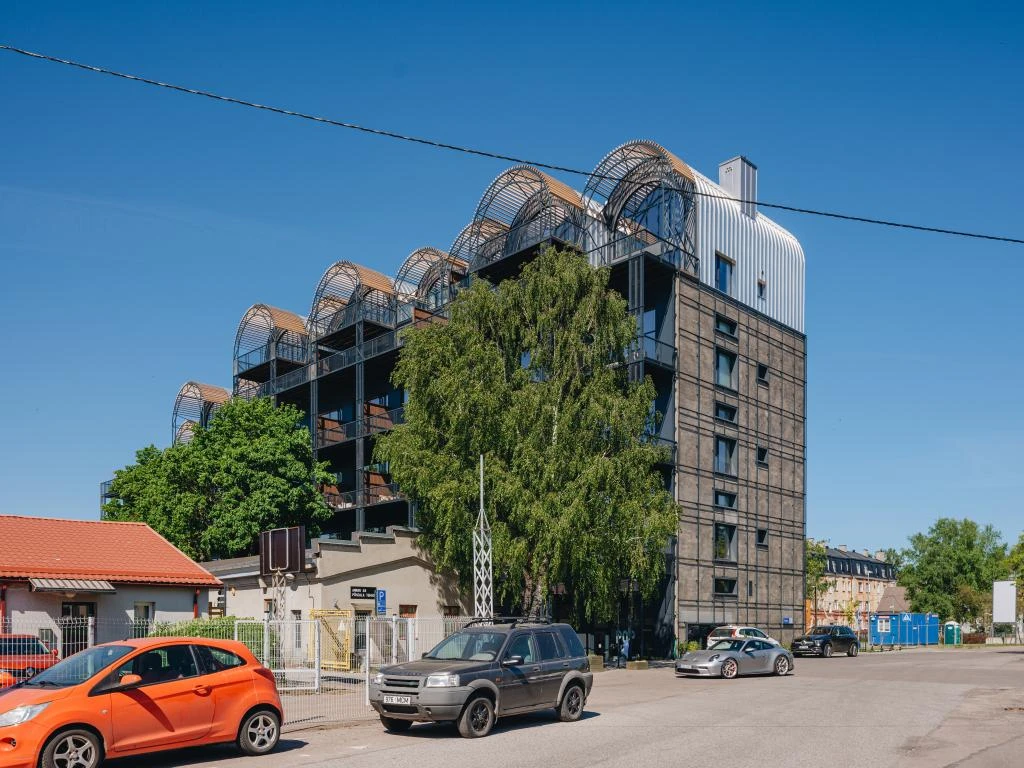
Reconstruction of the factory building at Ankru 8 into a residential building with studio apartments (photo: Tõnu Tunnel) – architecture: Karli Luik, Johan Tali (Molumba).
The development of the old Põhjala factory complex brings new life to a large area with different forms of living: studios and ateliers, offices and co-working spaces, apartments and lofts, galleries and exhibitions, cafes and restaurants are being created here. The Ankru 8 building is an important part of the reconstructed Põhjala center – significant and the tallest structure in the quarter, it is also a new living space creating a permanent community for the quarter. The Ankru 8 architectural solution values the existing. The added roof floor has clearly different aesthetics and signals from a distance that new vitality and new functionality have emerged in the quarter. The existing has been maximized both in the exterior and interior; the estakade that enters the building and carries historical functionality was preserved. The entire building facade is covered with delicate netting planned for climbing plants. This way the building changes over time and gradually acquires a greener appearance over the years.
M-building passage (photo: Sten-Erik Remmel) – architecture: Peeter Pere, Kirke Päss (Peeter Pere arhitektid).
The M-building is a central and large former industrial building in Telliskivi with visible layers of architectural history: from tsarist-era limestone railway workshops, with Soviet-era production enterprise additions, to today's cafes and bars and empty spaces awaiting new vitality and renovations. The building's size and location influence the area's use and visibly direct movement patterns, which previously flowed around the building's long perimeter. A new passage through the M-building's conceptual central axis creates a bridge between the Telliskivi quarter, the creative city, and public space. Red canopies mark the entrances at the tunnel's ends. Both the corridor and entrance canopies recall the form of a solemn pitched-roof space. Perforated metal is used as material to open the passage walker's view to the interior of the former industrial heritage. White irregularly placed pipe lights illuminate the corridor, connected by freely hanging and positioned red wires. The result is an installation created through architectural means.
Rae State Gymnasium and Tuule sports building (photo: Tõnu Tunnel) – architecture: Martin Tago, Lembit-Kaur Stöör, Merilin Jürimets, Raivo Kotov, Andrus Kõresaar, Xenia Sooniste; interior architecture: Raili Paling, Kadri Kaldam, Lilian Männikust, Liis Lindvere; landscape architecture: Eleriin Tekko, Katri Soonberg, Elina Koel (KOKO architects).
The plot chosen for the Rae State Gymnasium and sports building, located next to a large substation on Aruküla Road, was not inspiring in the classical sense, but rather imposed limitations. The architects' idea was to place the school building and sports building and the public space between and around them in such a way as to create a place with good vibes. Two recognizable wooden public buildings were constructed in the meadow. A board-concrete sound barrier was built on the road-facing sides, and the playful school courtyard behind it, built on different levels, harmonizes well with the school building's form. Both the school and sports building use the same outdoor areas and form a working ensemble together. The school building is spacious and functionally clearly structured. Inside the building you can find different scales, connecting passages, and plenty of natural light. The aim was to create a space that encourages and inspires learning and interaction. The sports building's central space is a hall with a gallery. Both Rae State Gymnasium and Tuule sports building's load-bearing structures are built entirely of wood.
Vana-Kalamaja Street reconstruction (photo: Martin Siplane) – architecture: Siiri Vallner, Indrek Peil; planting designers: Kadi Nigul, Kadri Uusen, Kristjan Nigul (Väli).
The Vana-Kalamaja Street reconstruction was a community-centered street project that reconnects the Old Town to the sea through Tallinn's oldest suburb, Kalamaja. The street values Kalamaja's long history and its diverse urban space and helps bring the local community together. The street space is shared between different users in such a way that it is clear and continuous regardless of mode of transport, although it is partially overlapping and multi-use. A unified, varied paving, a linden tree centerline, a rain swale, and lighting distribute the street surface among different users at the same level. Where the street was wider, stopping places were created and space for different activities was established, bringing out the character of adjacent plots with small squares (kindergarten, small park, playground, etc.). The street's focal points are two new urban squares – on the Baltic Station square, which concentrates the city's public transport, different waiting and meeting places have been created. Kotzebue Square is designed in a neighborhood-centered way as a place for different generations to spend time. Planting boxes along the street await the participation of local gardening enthusiasts.
Nominees for the Estonian Union of Architects' SMALL Award 2024:
City-Machine (photo: Gregor Jürna) – architecture: Mariann Drell, Ruuben-Jaan Rekkor; project team contributor: Johan Kirsimäe.
The pavilion "City-Machine" surrounding the Linnahall is at once a covered walkway, a street, a sign, a sculpture, a shelter, a fountain and much more, created with a single stroke – a nature shrine where we relate intimately to construction surplus and manifest the passage of time through the juxtaposition of fine new construction and old mass. "City-Machine" is both the result and essence of reuse. Columns are made from round logs left over from log house renovation, which the architects painted to match the turquoise tone of the Linnahall's lights. Metal elements made to order are painted orange. Metal elements ensure the work's durability over time. The fountain is built from limestone that has fallen from the Linnahall. The metal mesh roof is excavated from the city bedrock. A large concrete surface already present at the location and concrete blocks hold "City-Machine" in its time-worn and forgotten embrace. Building structures are designed with disassembly in mind – they are replaceable, movable, and adaptive as needed.
Logi sauna (photo: Liina Soosaar) – authors: Kaisa Sööt, Liina-Liis Urke, Margit Säde, Regina Viljasaar-Frenzel.
Logi sauna is a simple wood-fired public sauna built by citizen initiative on the seaside in central Tallinn. The design, construction, and daily management processes of the sauna have been collective, and the project's authors are themselves sauna keepers who heat the sauna three times a week during regular opening hours with volunteer help. By combining the authors' different sauna experiences and knowledge, an off-grid wood-heated space has been created that supports cooling in the sea, where there is as little as possible and as much as necessary. The temporary wooden building's heated and insulated part is completed at the factory and can be relocated as a complete module to a new location. The shelter part is built on site using construction techniques that allow it to be erected again in a new location if needed. The shelter surrounding the sauna is designed to protect the building from both strong sea winds and possible vandalism. The opening of large double doors gives the building flexibility and signals as an open shelter that the sauna is warm and open to visitors.
Creation of outdoor exhibition area elements for MOMU Motorsports Museum (photo: Tõnu Tunnel) – author: Villem Tomiste (Stuudio Tallinn).
MOMU Motorsports Museum created two outdoor exhibition areas in the MOMU garden, which were united into a whole on July 3, 2024, when the exhibition "Kalevi Great Ride 65" opened. The "Kalevi Great Ride" exhibition circuit signs are each of different shapes and visualize the trajectory of the curves. Information about each curve is placed on both sides of a circular 25 cm diameter disc, shaded by a small nosing on both sides, creating the impression of a traffic light.
Paljassaare seagrass pavilion (photo: Spatialist Studio) – author: Iiris Tähti Toom.
The Paljassaare pavilion brings material from the sea to land, experimenting for the first time in Estonian public space with seagrass as a building material. Seagrass (Zostera marina) has historically been used as furniture stuffing and in Denmark as construction and insulation material. The strap-leaved plant common in Estonian waters has great potential for the local construction market due to its rapid regrowth period and low carbon footprint. Rolled into recycled fish nets, the seagrass roof provides Paljassaare swimmers with a moment of rest and sun shade. The pavilion was completed as part of Tallinn city's Green Footprint project.
PÕHULA(va) (photo: Evert Palmets) – authors: Aneth Traumann, Liispet Viira, Rasmus Meema, Roosmarii Kukk, Triinu Amboja, Valerii Krinberg.
The opinion festival's base installation PÕHULA(va) offered different layers – an opinion room, stage, pavilion, exhibition, classroom. Panel construction, foundation, roof building, panel transport, lifting and fastening – such stages comprised the pavilion built on the principles of nature-based construction and field-to-field building. PÕHULA(va) can be called a prototype of the research group 1+ X's base wall panel development project. Base panels offer the opportunity to move toward circular economy and the use of biogenic materials, where buildings are like living organisms that do not end their life cycle in a landfill but decompose in a new building or in nature. In construction, architects have a major role in choosing materials that are not a burden to future generations.
Award winners will be announced at the architecture profession's joint ceremonial awards ceremony on January 23, 2025. Additionally, EAL will present a student award. This is funded annually by different EAL member offices. This year the award (1,350 euros) is supported by DAGOpen, Arhitektibüroo Emil Urbel, PIN Architects and KAUSS Architecture.
EAL's Architect's Award is 6,000 euros and the SMALL award is 5,000 euros, both supported by the Estonian Cultural Endowment.
A gallery of all nominees' works will be published on the joint architecture awards website www.arhitektuuripreemiad.ee and in the publication "Estonian Architecture Awards 2024"
Search
Keywords
Most read articles
- Price per Square Meter of Apartments in Tallinn in 2025
- Apartment Market in Early 2026: Prices Rising, Transaction Activity Remains Modest

- Apartment Market in Early 2026: Prices Rise, Transaction Activity Remains Modest
- Estonian Apartment Prices and Market Expectations in 2025
- Notary Fee and State Fee – Who Pays and How Much?