The Jury of an International Architecture Competition Selected a Design for a New High-Rise Building in Tallinn's City Center
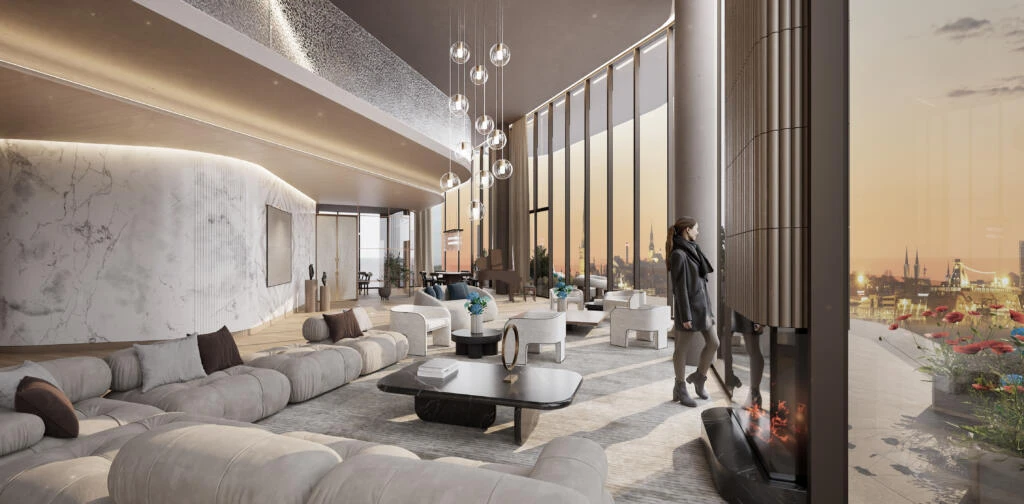
The jury selected "Lumière," a joint work by French and Estonian architects, as the design for a new high-rise building to be constructed in central Tallinn at Tartu maantee 17 during an international architecture competition.
Interest in the architectural ideas competition was considerable: a total of 87 architecture firms and teams from Estonia and beyond expressed their desire to submit their vision, and among the interested parties were several renowned professionals known worldwide. The competition jury advanced eight participants from the first round, and from their submitted works, the best was selected as the joint work of French architect Marcelo Joulia's architecture bureau Naço and Estonian architecture bureau Eek & Mutso Architects, titled "Lumière," which means light in French.
The winning work is an innovative high-rise building with a green mindset that brings residential spaces worthy of the capital to Tallinn's central business district and creates a new urban environment. The building has a sustainable design that maximizes the use of natural resources and takes into account the local climate. The building consists of residential spaces, commercial space, and spaces for public use, which will include, for example, a café, restaurant, art gallery, and wellness center. At the center of the building is a platform with panoramic views open to city residents.
Since the area's high-rise building zoning plan permits the construction of buildings up to 130 meters high, all architects participating in the competition utilized this limit in their designs. The winning work is designed as a building 125 meters high from ground level. This is comparable in scale to other existing and planned high-rise buildings in the Maakri area.
The jury is satisfied with the result
Jury member and former head of the Estonian Association of Architects Ülar Mark stated that the Maakri district in Tallinn is planned for high-rise construction, which could also accommodate taller buildings. "This must be justified both functionally and in terms of Tallinn's city skyline. In the case of the winning work, the height is justified. It is not a closed business tower, but is open to city residents," he said. According to the jury, the winning solution brings both permanent residents and the necessary dynamics to the city center in the best possible way.
According to a representative of the City of Tallinn, the winning work offers novelty to the Maakri high-rise area and helps make the area more human-friendly and more open to city residents. "The winning work brings several functions that enrich street space, such as an art gallery, event space, cafés, and restaurants," commented Tallinn Strategy Center architect-urban planner Jaak-Adam Looveer. "It also adds greenery to Viiralt Street and connects the surrounding city areas, bringing the Maakri district, Tallinn Jaani Seegi Church, and Politsei Park closer to each other, which have so far remained separate."
According to jury chairman Andrus Väärtnõu, the selected work takes into account the competition's terms of reference and vision to create a building that values both the city panorama and environment. "This building will certainly become a city landmark, a quality living environment, and a new popular destination for both city residents and international visitors. We are satisfied with the competition results: an extraordinarily large number of architects showed interest in the project. As a result of the visions presented, we received a wide range of solutions, from which the jury selected the best. For the first time, internationally renowned bureaus that our region had not previously attracted wished to participate in the architecture competition," explained Väärtnõu.
The winning work enriches the surroundings
Internationally acclaimed architect and designer, founder of architecture bureau Naço Marcelo Joulia has created renowned buildings, hotels, and restaurants around the world, for example in Paris, Dubai, Shanghai, and Buenos Aires. According to Joulia, the new building complements Tallinn's skyline and connects nature with urban life. "The Lumière design has two pillars: environment and innovation, which reflect our commitment to a more sustainable way of life," he noted. According to the architect, it stands out from other buildings through its streamlined form, which is inspired by the rounded forms of urban architecture and the towers of the old town fortification wall. The building will come in light tones, which in turn are inspired by Estonian nature, auroras, reflections on sea and snow. "As the name itself suggests, this high-rise adds light to both the city's panorama and brings brilliance to people's everyday lives," added Marcelo Joulia.
"We try to put something into each project that distinguishes the solution from what has been done before," said the winning work's co-author, founder and architect of architecture bureau Eek & Mutso Madis Eek. According to Eek, the high-rise architectural competition in cooperation with international architects was of special importance for the Estonian bureau. "The location is familiar to us; on the other side of Tartu Avenue is the first building created in our bureau – the Tornimäe building completed in 1998."
The competition jury, which selected the competition winner, consisted of renowned architects. The jury was composed of members of the Estonian Association of Architects Ülar Mark, Risto Parve and Siiri Vallner, architect Jaak-Adam Looveer from the Tallinn Strategic Planning Service. The jury also included client representatives Andrus Väärtnõu, Urmas Past, and Hannes Roosaar.
Second place was awarded to the joint project of the internationally renowned bureau Gensler and Estonian bureau Architect 11. Third place was won by the joint project of Estonian and international bureaus "Heaven 17," whose authors are Alver Architects and Studio Woodroffe Papa in cooperation with bureaus Whitby Wood, XCO2, and Studio Weave.
The area is being developed jointly by Elon OÜ and OÜ Viis Veeringut.
Photos of the design: Tartu mnt 17 winning solution
Photo author: Naço Architectures
Search
Keywords
Most read articles
- Price per Square Meter of Apartments in Tallinn in 2025
- Apartment Market in Early 2026: Prices Rising, Transaction Activity Remains Modest

- Apartment Market in Early 2026: Prices Rise, Transaction Activity Remains Modest
- Estonian Apartment Prices and Market Expectations in 2025
- Notary Fee and State Fee – Who Pays and How Much?