What to Keep in Mind When Decorating a Balcony and Choosing Plants?
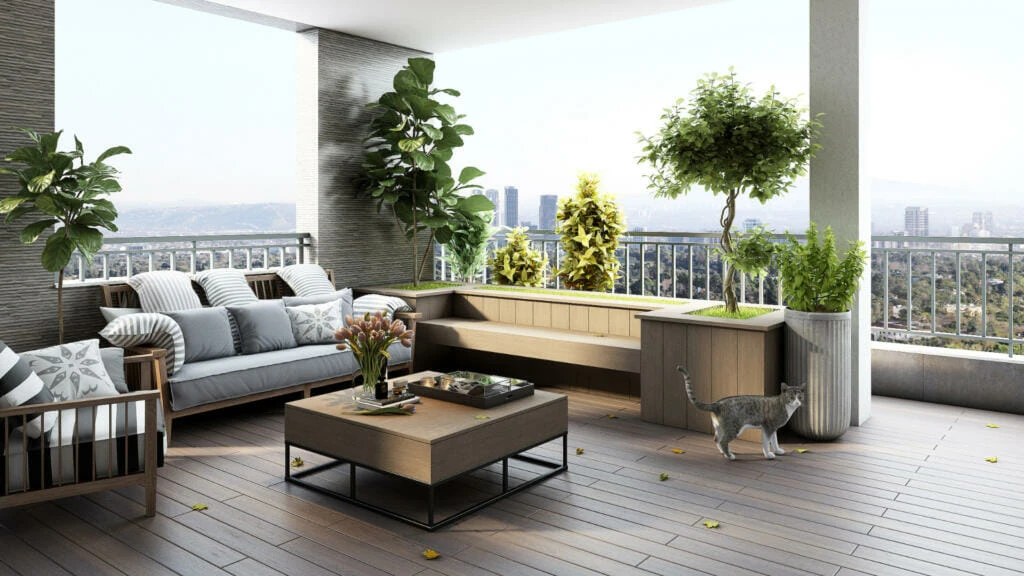
The arrival of the first spring days makes Estonians' eyes shine and they look for opportunities to catch every ray of sunshine. In the city, the easiest way to enjoy spring is by greening up your balcony.
Estonians love their balconies, various studies show that over 75% of new home buyers consider the presence of a balcony very important. That's why Bonava homes always have a balcony or terrace. Studies also clearly show that the space outside the rooms plays an important role in being happy. Bonava conducted a study in its markets that clearly revealed Estonians' love for outdoor space. The willingness of Estonians to have shared outdoor space with neighbors is significantly higher (37%) than in neighboring countries (average 20%). It's no wonder then that balconies have experienced a renaissance.
Decades ago, balconies were for storing things, many people even closed off their balconies entirely, which usually ended up with a cold extra corner in the apartment and the building's exterior looking ridiculous. In new apartment buildings, the layouts are well thought out and apartments have storage spaces, plus new buildings have pantries. Clotheslines have also been replaced by dryers in modern apartments. So the balcony has risen back into favor and become a place where you can relax, entertain guests, and try your hand at growing plants.
Bonava interior architect Grete Laan confirms that even a small balcony adds a lot to an apartment if it's decorated cozily. Even if you only have 2-3 square meters of balcony space, it's worth paying special attention to decorating it. You should start with the floor, she says. The concrete floor should be covered with wooden boards or terrace tiles. Wood and its imitation feel pleasant underfoot and makes the outdoor space feel like an extension of the room. When choosing materials, keep in mind that ordinary treated wood needs to be oiled almost every summer to keep the floor weather-resistant and looking good. With composite, you don't have this worry. Grete Laan recommends also using a rug on wooden balconies, which adds coziness and comfort to the balcony. You should definitely use a rug specifically designed for outdoor conditions. These can be easily cleaned by shaking and can be left out in both rain and sun.
Before planting on your balcony, you should definitely pay attention to which direction your balcony faces. A west-facing balcony is mainly semi-shaded. Most light there is in the evening. Such a balcony suits most plants. Only plants that love very warm climates don't feel comfortable on a west-facing balcony.
An east-facing balcony is also semi-shaded in terms of conditions. Most light is there in the morning. In terms of temperature, it can be slightly cooler than a west-facing balcony. On an east-facing balcony, plants that love semi-shade feel best.
A south-facing balcony is the warmest and sunniest. Here, plants that love dry and warm climates feel comfortable, but you can also plant shade-loving plants here. During midday heat, you should shade the plants from direct sun, as scorching sun can harm even the most resilient plants.
A north-facing balcony only gets sun briefly in the morning and evening. Therefore, plants that love shade and partially shade-loving plants feel best there.
A small cheat sheet for planting – sun-loving chives, lemon balm, rosemary, basil, tomato and lemon thyme. In semi-shaded places, various salads, dill, cilantro and spinach feel good.
Bonava interior architect Grete Laan adds that if you're afraid of bees and wasps, choose herbs instead of flowering plants or simply green plants without flowers. To prevent flowers from taking up floor space, it's most sensible to place them on the edge of the balcony or against the railing. Herb pots can also be hung decoratively on the wall. For planting, use soil that is specifically designed for balcony plants, as it retains water better and contains necessary nutrients. When creating a garden on such a small space, every centimeter should be carefully planned, but not planted too densely, as even the most resilient plants, herbs and flowers need space to grow strong. You should definitely think carefully about the entire watering system so that water doesn't drip onto the floor and from there onto the balcony of the neighbors below.
When choosing furniture, the interior architect recommends preferring a metal and airy table and chair set. Different textiles and cushions can be used for softening. Wooden furniture tends not to last in our climate, plus it's quite cumbersome to often take apart and put back together. If your balcony has any room at all, you can plan a storage bench at one end. You can conveniently hide all textiles from the rain there. For a small balcony, you can attach a table to the railing or wall.
However, cozy lighting is extremely important. In recent years, the selection of light chains, lanterns and lamps has become very good and you will certainly find one that suits you. The specialist recommends using warmer, so-called yellow light.
A properly decorated balcony also significantly increases the value of the apartment – primarily of course because it offers family members better quality of life. However, having one is also beneficial later if you want to sell the apartment, as apartments with balconies are very much in demand among home buyers.
Search
Keywords
Most read articles
- Price per Square Meter of Apartments in Tallinn in 2025
- Apartment Market in Early 2026: Prices Rising, Transaction Activity Remains Modest
- Apartment Market in Early 2026: Prices Rise, Transaction Activity Remains Modest
- Estonian Apartment Prices and Market Expectations in 2025
- Notary Fee and State Fee – Who Pays and How Much?