Maakri Quarter's Future Appearance Complements Tallinn's Skyline with Three Skyscrapers
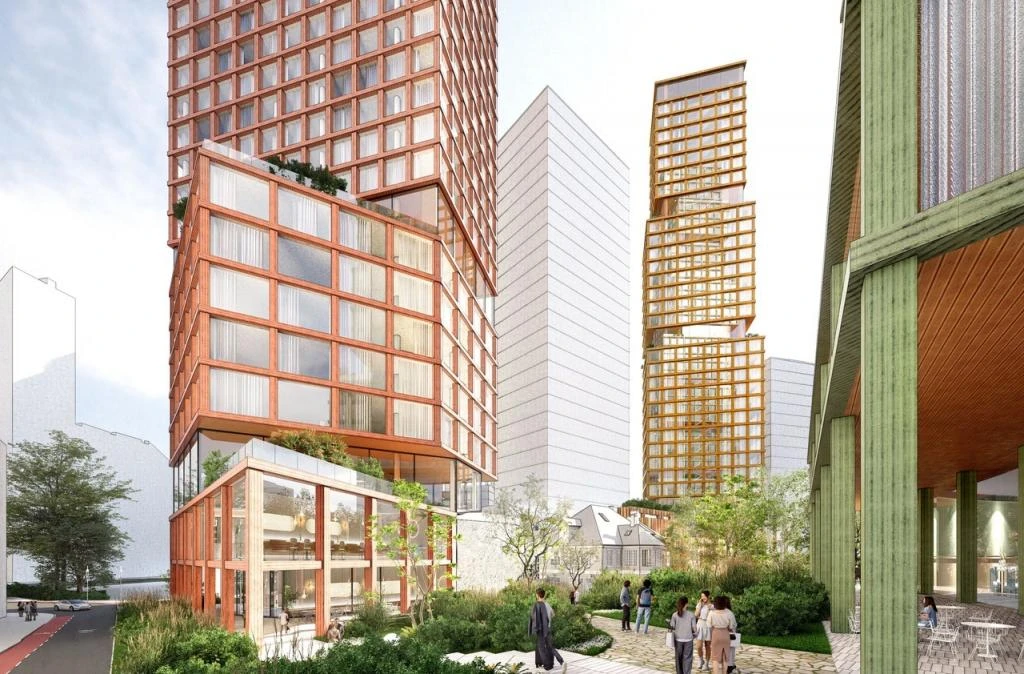
The architectural competition for Maakri Quarter, conducted in cooperation with Kolmas Arendus (a company under Capital Milli's management), real estate company Robalm, and the Estonian Architects' Association, proved successful, and the winning design was declared to be the work "Trinity" by architectural bureau molumba.
According to the competition brief, nearly half of Maakri Quarter's area must be transformed into a green city park, the streetscape must be pedestrian-friendly, and the former E. Lender Gymnasium building must be restored.
The magical 130-meter limit was surpassed
"Competitions of such large scale do not take place often in Estonia, especially not on such a scale that affects the city's silhouette. It is clear that work will continue for several years and the solutions will develop significantly further during the planning and design phase, but the winning work provides a very good starting point for this. The merits of the winning work were evident both in the spatial arrangements and height variations as well as in well-resolved traffic routes, which ensure that the place becomes an organic part of Tallinn's city center," commented Tõnis Arjus, jury member and member of the Estonian Architects' Association.
According to Arjus, the winning work stands out primarily because it is not a single-plot solution, but a larger whole, where the focus of the place becomes a central public and green space, which will likely become the heart of the entire Maakri area. "Since the development area is planned to have several different functions, where living and working environments complement each other, we can expect the entire area to become more vibrant, which supports Tallinn's goal of developing as a human-centered city," Arjus expressed his hopes.
Tanel Samuel, co-owner of Capital Milli and jury member, said the competition was undoubtedly ambitious and provided a good overview of how the area could be spatially resolved. "What was pleasing about the winning work was how the architects approached it boldly and tested the limits by moving into greater heights. The initial task allowed for going higher than 130 meters this time, which is usually an unwritten rule and limit for developers and architects. Exceeding this constraint provided an opportunity to create innovative, exciting, and contemporary solutions, while still integrating nicely into the existing environment," said Samuel.
Within 10 years, Maakri Quarter will become a metropolitan area
According to Tanel Samuel, the most complex part of the development will likely be the detailed planning process, but the city government has suggested that the process could be completed within three years. "The speed of the process is currently the most important factor and we hope very much that the allowed timeframes will hold. The architectural competition, design, and construction could together take about 10 years," Samuel believed.
The solution offered in the winning work "Trinity" proposes three separate high-rise buildings for the area, and the former Lender Gymnasium located in the center of the area will receive an extension between Maakri 28 and Skyon's rear walls, which together will form a new kindergarten building. The three separate high-rise buildings and the kindergarten located between them will be separate development areas that can be developed further independently. All planned high-rise buildings are vertically segmented, so that every 5-10 floors there is a more open and higher intermediate floor that can be used as a recreation area open to the public.
The new quarter will become the heart of Tallinn's high-rise building area, with the planned park area at its center creating a breathing pause amid the towers rising around it. Maakri Quarter will become a dense and diverse metropolitan area oriented toward pedestrians.
Wide promenades, plenty of sunlight, and lush green areas
The heart of Maakri's high-rise quarter will become easily accessible to pedestrians in every direction. Both the direction of traffic on Tornimäe Street and the direction running between the Lender Gymnasium and Skyon are resolved with sufficiently wide promenades. At street level, the future buildings are partially open for the extent of the first floor. In several places, the sidewalk has been drawn entirely under the buildings, thus freeing up maximum space for greenery.
The park area preserves the tall vegetation located in the southern part and forms three separate zones parallel to Kuke Street, which are divided by the Tornimäe Street axis and the pedestrian area running from the Lender Gymnasium to Lennuki Street. The southernmost area is the brightest and wildest, where much of the existing vegetation is preserved. At Maakri 34, the western ground has been raised so that the second floor of the new building would open to the park area, creating an opportunity to establish pleasant functions opening onto the greenery on the second floor.
The park located in the center of the quarter creates a gently sloping green area toward the future kindergarten, with a park pavilion planned at its center, which could be used by both the kindergarten and park visitors. The high-rise buildings are planned for the eastern, western, and northern corners of the quarter, which allows it to remain open to the south – thus the newly created park receives maximum sunlight despite the planned tall towers.
The high-rise buildings are positioned on the plot in such a way that good views are ensured from both the new and existing skyscrapers. The buildings planned on the edge of Maakri Street are therefore rotated at a 45-degree angle compared to the existing towers, which allows views from the windows of all buildings to pass by other towers.
The organizer will begin negotiations with the competition winners to conclude a framework agreement for the preparation of detailed plans and the public space and architectural part of Maakri Quarter, as well as a contract for the preparation of the architectural and landscape architecture part of the city park construction project.
A total of 10 concept designs were received for the competition, of which 9 qualified.
The competition prize fund was 64,000 euros and the jury decided to award prizes as follows:
I Prize (20,000 €) for the concept design "TRINITY", authors: Johan Tali, Karli Luik, Harri Kaplan, and Heidi Urb from architectural bureau molumba
II Prize (16,000 €) for the concept design "SÜDA" authors: Andrei Paladjuk, Kristina Kaev, Eleonora Bublikova, Georgy Karyagin, Anna Gallat, Ivan Gavrilov, Jelena Kazak, and Francesco De Luca from architectural bureau Panda, company VANARC, and Tallinn University of Technology
III Prize (12,000 €) for the concept design "JÕEORG", authors: Carmen Lee, Ella Aho, Merve Ünlü, Tuuli Toivonen, Sandrer Aas, and Aaron Renser from architectural bureaus Architect 11 and Lundén Architecture (Finland).
Encouragement Prize (8,000 €) for the concept design "JAANITULED", authors: Margit Mutso, Inke-Brett Eek, Noa Smolin, Ander Roosipuu, and Madis Eek from architectural bureau Eek & Mutso
Encouragement Prize (8,000 €) for the concept design "MEISTRITE LINN", authors: architects Ingrid Viskus, Lembit-Kaur Stöör, Lera Mikhailova, Martin Tago, and Raivo Kotov, landscape architect Eleriin Tekko, and 3D illustrations by Tatiana Päss from KOKO architects.
The competition brief was coordinated by the Tallinn City Planning Department, the Spatial Creation Department of the City Strategic Planning Service of the Tallinn Strategy Center, and the Estonian Architects' Association.
The jury consisted of: jury chairman Tanel Samuel, representative of Kolmas Arendus OÜ, Igor Mölder, managing director of Capital Mill OÜ, Even Tudeberg, representative of Robalm OÜ, Oliver Alver, deputy director of the Tallinn City Planning Department, architects Marika Lõoke and Tõnis Arjus as representatives of the Estonian Architects' Association, and Karin Bachmann, a member of both the Estonian Architects' Association and the Estonian Landscape Architects' Association. Additionally, the jury involved heritage protection expert Oliver Orro in the work, and experts also participated including Reet Kalmet, project manager of Capital Milli's design work, and Silver Neemelo, construction director of Capital Milli and representative of Kolmas Arendus OÜ.
You can familiarize yourself with the competition and awarded works here.
You can familiarize yourself with all works received for the competition here.
The competition brief is visible here.
Search
Keywords
Most read articles
- Price per Square Meter of Apartments in Tallinn in 2025
- Apartment Market in Early 2026: Prices Rising, Transaction Activity Remains Modest

- Apartment Market in Early 2026: Prices Rise, Transaction Activity Remains Modest
- Estonian Apartment Prices and Market Expectations in 2025

- Notary Fee and State Fee – Who Pays and How Much?