Apartment Affordability Improves Significantly This Year
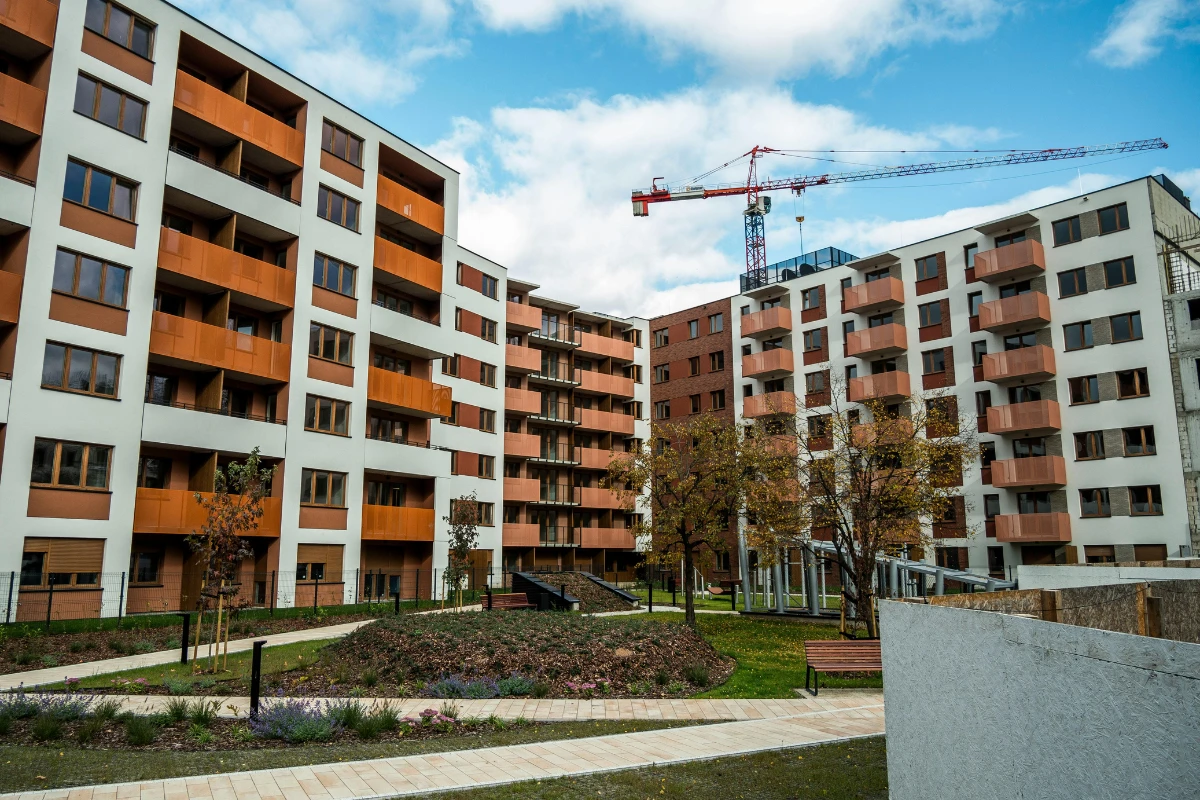
The past year has been characterized by a large gap between new developments and the secondary market in Tallinn's apartment market. Increased demand has concentrated mainly on the secondary market, supported by its more affordable price level. Although the interest rate reduction cycle is now complete, housing demand this year is supported by strong net wage growth, which is growing faster than price increases and apartment affordability is improving.
Apartment affordability has improved faster on the secondary market
Both in the fourth quarter and throughout 2025 as a whole, the average net wage in Tallinn was, according to Swedbank's forecast, about 3% higher than a year earlier. Thus, in 2025, net wage growth was slightly faster than price growth on the secondary market (+2.6%), but the growth rate was similar to new development prices (+3.0%).
According to Swedbank's estimates, a household in Tallinn with 1.5 times the average net wage* could afford a 74-square-meter apartment on the secondary market in the fourth quarter last year, compared to a 68-square-meter apartment a year earlier. Based on developers' asking prices, it was possible to buy an average of approximately 42-square-meter apartment in new developments at the end of the year, compared to up to a 38-square-meter apartment a year ago.
The price difference between the secondary market and new developments was already at a high level for the third consecutive year – last year the difference was 44%. The lowest price difference was in 2019, when new developments were on average 34% more expensive than the secondary market.
Since the beginning of 2023, apartment affordability has improved faster on the secondary market than in new developments. In the final quarter of last year, it was possible to acquire an average of 20 square meters larger apartment on the secondary market compared to the beginning of 2023, while in new developments it was 10 square meters larger than two years earlier.
Apartment affordability improves noticeably at the beginning of this year
The European Central Bank's interest rate reduction cycle has likely come to an end this time. This means that housing affordability this year depends mainly on price and net wage dynamics.
The elimination of the tax wedge does support net wage growth this year, but it mainly benefits employees earning above the median. According to Swedbank's forecast, the weighted average net wage in Estonia will grow by 10% this year. Strong net wage growth should in turn support housing demand. Along with better wage purchasing power prospects, household confidence has already improved significantly.
Gradually increasing demand may start to accelerate price growth on the secondary market. However, most of the factors that previously drove new development price growth (rapidly declining supply, reorientation toward wealthier buyers during high interest rates, tax increases) have now been left behind.
New development supply has gradually increased over the past three years. At the end of last year, it approached the peak levels seen in 2018. Sufficiently large supply, while demand is still significantly below historical averages, limits new development price growth. This could in turn gradually begin to reduce the price difference between the secondary market and new developments.
Since wage growth is faster than price growth, apartment affordability improves noticeably this year.
Tallinn's new development affordability is worse compared to Riga and Vilnius
According to Swedbank's calculations, a household in Riga could on average afford a 61-square-meter apartment in a new development in the fourth quarter. In Vilnius, a 60-square-meter apartment was affordable in a new development. In Tallinn, the corresponding figure was 47 square meters, based on the Land Board and Spatial Planning's transaction statistics. Since these are previously concluded agreements that appear in statistics with a time lag, the affordability of apartments in new developments currently on the market is actually lower.
On the secondary market, a household in Vilnius could on average access a 67-square-meter apartment in the third quarter. Although comparable data for Riga is lacking, the situation there with the affordability of secondary market apartments is generally better than in Tallinn and Vilnius.
Vilnius's apartment market has been the most active compared to Tallinn and Riga so far, and this year it is likely to experience even faster growth momentum from the second pension pillar reform, which allows people to withdraw their savings from it. Large transaction activity has already accelerated apartment price growth in Vilnius and may start to worsen apartment affordability this year.
Search
Keywords
Most read articles
- Price per Square Meter of Apartments in Tallinn in 2025

- Apartment Market in Early 2026: Prices Rising, Transaction Activity Remains Modest

- Apartment Market in Early 2026: Prices Rise, Transaction Activity Remains Modest
- Estonian Apartment Prices and Market Expectations in 2025
- Notary Fee and State Fee – Who Pays and How Much?