Spring Maintenance Awaits: How to Treat Your Terrace So It Doesn't Become Sticky or Stained
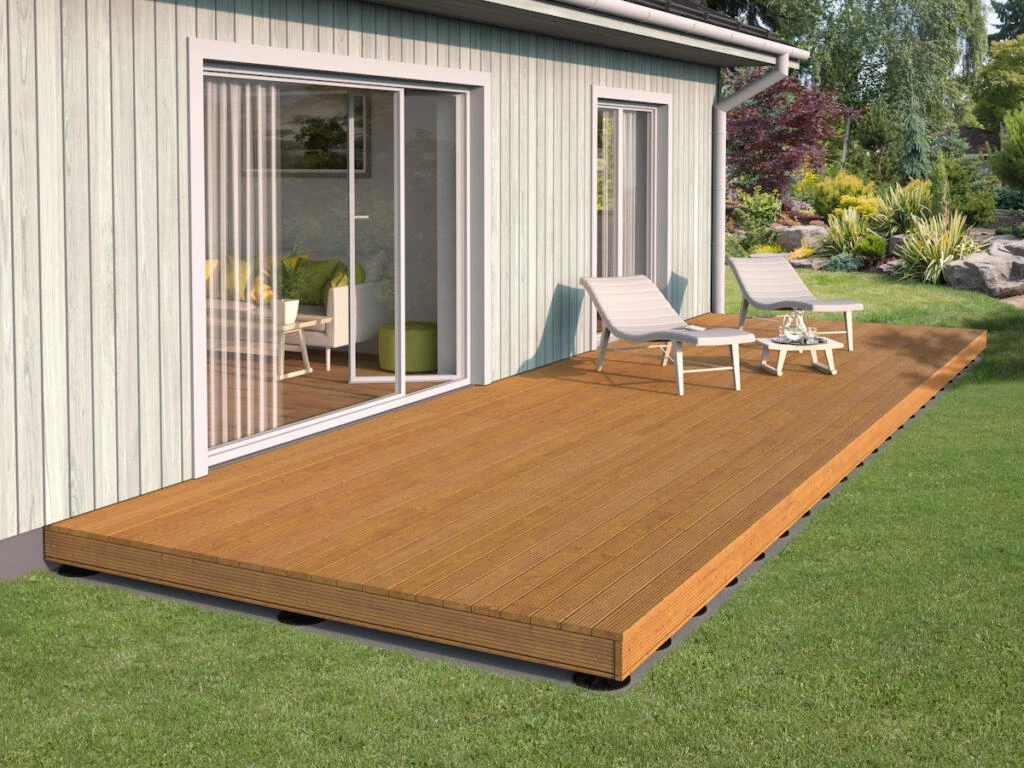
According to Mari-Liis Mihkelson, the manager of the Tartu branch of Puumarket, the largest timber retailer in the Baltic states, deck boards should be maintained and oiled in spring, and there are special tips to make the work quick and achieve the desired result. However, Mihkelson recommends not touching brand new decking and certain types of wood for years at all.
According to Mari-Liis Mihkelson, brand new deck boards should not initially be treated with finishing or protective agents. "Rather, you could let the new floor stand in the weather for a year or two, during which time the sun will burn out the impregnation from the surface wood pores and new finishing can soak in properly. This is especially important if you want to change the color of the deck boards, otherwise the original impregnation can alter the tone of the finish and the result will be patchy," said Mihkelson.
"Currently, naturally grey-toned decks are very popular, which is the color wood becomes on its own when exposed to the weather. For example, thermally treated wood starts out brownish or golden, but turns grey over time. If you like the greyish tone, then thermally treated wood is actually so durable that it doesn't need frequent maintenance at all. However, if the goal is to preserve the original brown tone, then a few years after installation, the material can be refreshed with pigmented oil that has UV protection," Mihkelson suggested.
Larch deck boards cannot be treated for several years
"Since Siberian larch is no longer produced from Russia, similar European larch is used instead, whose light tone gradually turns silvery-grey. Since larch naturally contains a lot of resin, it is not possible or necessary to impregnate it for the first couple of years," said Mihkelson.
"If you start applying an oil layer too early, the wood won't absorb it and the surface will remain sticky. For later refreshing, linseed oil works best for larch. However, if you want to preserve the natural grey tone, then the surface should be cleaned and treated with oil without pigment," Mihkelson suggested.
Too thick a layer of oil will remain sticky
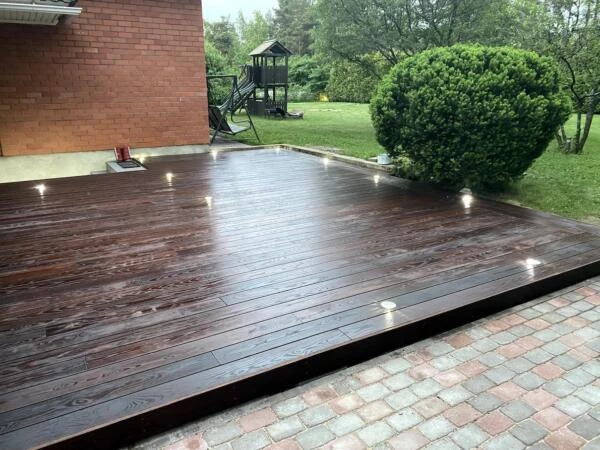
According to the manager of Puumarket's Tartu branch, deck maintenance should begin by cleaning the surface with a special tool to remove the old oil layer. "Otherwise, the new oil layer will soak in unevenly into the material and the result can be patchy," said Mihkelson.
"Textured boards are slightly more difficult to clean compared to smooth ones, which is why people are increasingly preferring the latter. When cleaning a textured surface, it is important to also clean the grooves of dirt and sand, which prevents the oil from getting to the surface properly," added Mihkelson.
"After cleaning, you must let the surface dry, and only then oil it. It is important that the wood becomes saturated with oil, but any excess oil that remains shiny on the surface should be wiped away with a cloth about half an hour later, otherwise it may become sticky underfoot. After the first oil layer dries, you can add a second layer if necessary," said Mihkelson.
Fire hazard – you must be careful with oily cloths!
According to Mari-Liis Mihkelson, special deck oiling sponges are sold, which can also have a handle attached, and this way the work can be completed many times faster than, for example, with a brush.
"When using wood oil, it is very important to follow fire safety precautions. Textiles and sponges used for applying oil can easily catch fire. As a result of friction, heat builds up inside the cloth, or we could say it becomes charged. Oil dries slowly, and if the cloth with the substance remains crumpled and doesn't get air, then the temperature can rise and eventually catch fire," noted Mihkelson.
"After work, oily cloths and sponges should either be spread out to dry, stored in a covered container or in water, and not simply thrown in the trash, where they could ignite on their own," warned Mihkelson.
Search
Keywords
Most read articles
- Price per Square Meter of Apartments in Tallinn in 2025

- Apartment Market in Early 2026: Prices Rising, Transaction Activity Remains Modest

- Apartment Market in Early 2026: Prices Rise, Transaction Activity Remains Modest
- Estonian Apartment Prices and Market Expectations in 2025

- Notary Fee and State Fee – Who Pays and How Much?