Is Tallinn Business Center Moving to the Seaside?
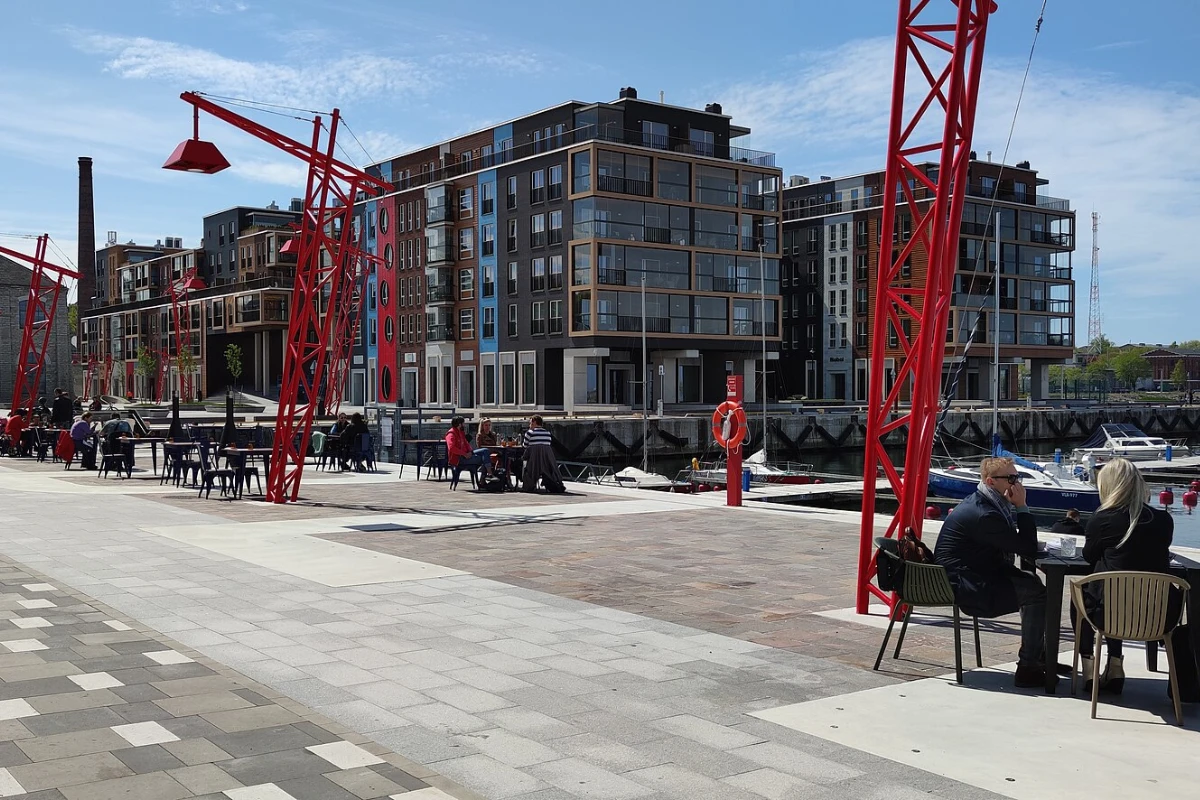
Tallinn's business center is expanding towards the sea. The Rotermann quarter has developed into a significant business area, Golden Gate has added new office spaces to the port area, and SEB plans to move its Baltic headquarters from Tornimäe to the Talsinki quarter. At the same time, the Telliskivi and Krulli areas are developing. Does this mean that the Maakri and Liivalaia area, considered Tallinn's business center for decades, will start losing its importance? It's not quite that simple. Swedbank moved its headquarters from its previous Liivalaia location to the Arteri quarter, essentially remaining in the same area. Ülemiste City also shows that a strong business environment can develop outside the traditional city center. Rather, the question arises whether Tallinn even has one clearly defined business center, and what constitutes a good location for today's office tenant.
Companies don't choose locations in the same way
In economics, there is the concept of agglomeration effect – the economic benefit created by the concentration of companies. Banks, law firms, and consulting companies can benefit from proximity to clients and business partners. Additionally, a prestigious address plays a role in a company's image. For a technology company or a large support services center, however, employee accessibility, the labor market, and the surrounding environment may prove more decisive. According to Tallinn University's 2023 downtown business environment study, only approximately one-sixth of the city's office jobs were located in Tallinn's business center. In the Helsinki metropolitan area, by contrast, approximately half of office jobs were concentrated in the business center. This shows how dispersed Tallinn's office jobs are. However, CBRE's 2026 Nordic office tenant survey shows that the importance of the city center has not disappeared: 87% of real estate decision-makers from surveyed companies preferred the city center or its immediate surroundings. A prestigious location, accessibility of services, and proximity to other companies remain important.
Is a good location where the clients are or where the employees live?
An interesting contradiction emerges in Tallinn's office market. New waterfront business quarters offer an attractive urban environment, restaurants, and services. At the same time, there are companies whose employees live in Mustamäe, Nõmme, or Tallinn's surrounding municipalities, for whom convenient access by car and parking are important. For such a company, is an office in Rotermann necessarily better than one on Tammsaare Road, Sõpruse Avenue, or Pärnu Road? Not necessarily. A good location depends on the company's field of activity, clients, employees' commute patterns, and work organization.
The location doesn't change, but its value can
A good example is Swedbank's former headquarters at Liivalaia 8/12, which has approximately 22,500 square meters of office space. For decades, it was the home of one of Estonia's largest banks. Now the new owner must answer the question of which tenants this building might suit. The location hasn't changed after all. It is still in the city center, where banks, law firms, and other business service companies are located. However, what worked for decades as one large bank's headquarters may not satisfy the next tenant's expectations in the same form. Could the building appeal to several medium-sized companies? Would the central location and possible price advantage outweigh the benefits of newer office buildings? And how many such potential tenants actually exist?
An investor doesn't just buy a location, but the demand for it
In real estate investment, location has always been considered one of the most important value determinants. However, an office building in a prestigious business area may not be a risk-free investment if the pool of suitable tenants is narrow and competing space is being added. On the other hand, a functional office building in a location far from the city center but with good accessibility can provide stable cash flow. Tallinn's business center isn't moving to the waterfront; rather, it's expanding and becoming more polycentric. The development of Rotermann and the port area doesn't mean that the Maakri, Liivalaia, or Mustamäe office areas will lose their importance. However, competition for tenants is becoming more intense, and each area must now more clearly offer value specifically to those companies whose needs it best serves.
Therefore, for a real estate investor, the most important question is not just whether this is a good location. The question to ask is: for whom is this a good location, and how many such tenants actually exist in the market?
Search
Keywords
Most read articles
- Price per Square Meter of Apartments in Tallinn in 2025

- Apartment Market in Early 2026: Prices Rising, Transaction Activity Remains Modest

- Apartment Market in Early 2026: Prices Rise, Transaction Activity Remains Modest
- Estonian Apartment Prices and Market Expectations in 2025
- Notary Fee and State Fee – Who Pays and How Much?