Is Wooden Architecture Really More Carbon Neutral Than Concrete?
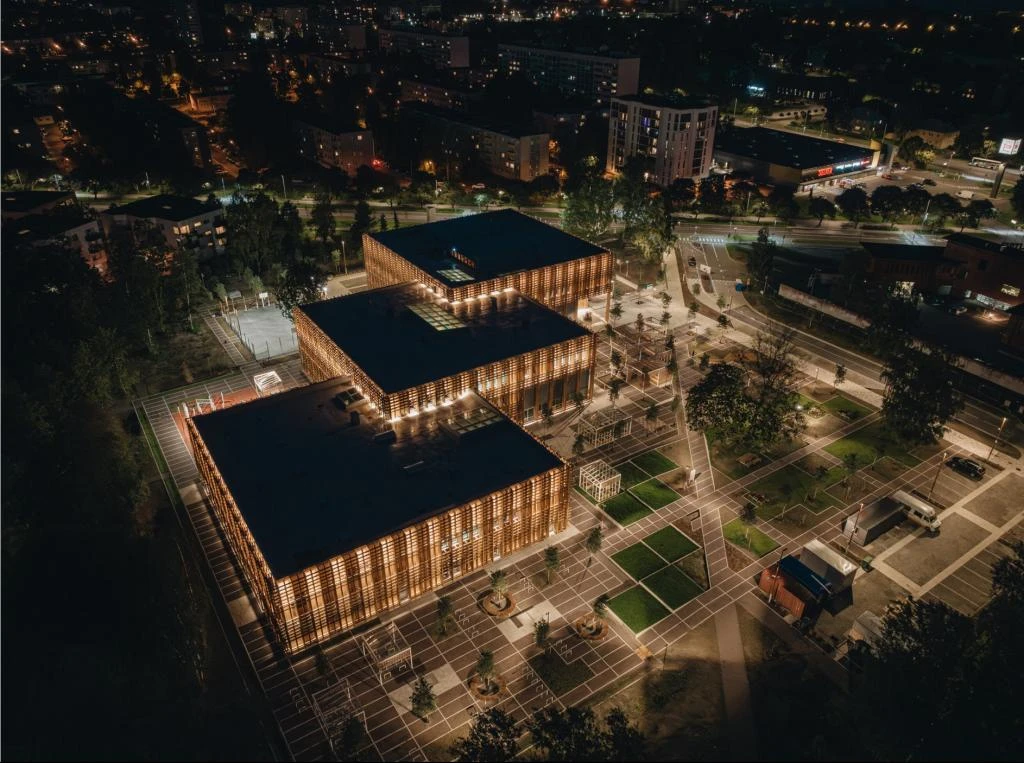
At the Estonian Association of Architects' climate seminar "Who is the architect of climate?" a discussion emerged about whether building with wood is really as carbon-neutral as we have believed in recent times. When measuring the carbon footprint of two state gymnasium buildings, it became clear that the situation is not so black and white.
Architect Alvin Järving from the architecture bureau Architect Must noted that in recent years, timber architecture has been a symbol of carbon neutrality in architecture and building construction, and the understanding that building with wood is carbon-neutral has been like a rule of thumb. "Wood has strongly established itself in all sorts of architectural competition conditions, and we as architects have also invested for years in improving the world through the use of wood," added Järving.
Not a single log stands upright on its own good faith
Architect Must, known as a master of school buildings, has unfortunately had to abandon wood on several occasions, bumping into reality – namely the clients' budgets. This happened, for example, with Tabivere Primary School, Kärdla School, and Mustamäe State Gymnasium (MURG) – in all three school architectural competitions, the possibility of building with wood was described, but ultimately the buildings were constructed from concrete and steel, using wood as a decorative or facade material.
The fourth attempt succeeded, and Estonia's largest timber building to date is Pelgulinn State Gymnasium (PERG), built in 2020. However, it is interesting to compare the carbon footprint of Mustamäe State Gymnasium, built from concrete, with that of Pelgulinn State Gymnasium, built from wood. Both are the same size and have uncompromising architectural language in their details, but their construction budgets were very different. MURG, built during the same period, cost around 16 million euros, while PERG cost 25 million.
Kadri-Ann Kertsmik, an expert from TalTech's Institute of Civil Engineering and Architecture, explained that when measuring the lifecycle footprint of buildings, account is taken of the production of building materials, transport, construction waste, costs related to the building's operation, including maintenance, repairs and energy used, as well as the potential impact of building demolition and waste processing. The building's lifespan, which forms the basis of all these calculations, is 50 years. The largest part of a building's lifecycle footprint is made up of energy consumption during use, but in the built structure itself, account is also taken of the footprint of technical systems, facade materials, foundations, and building frames.
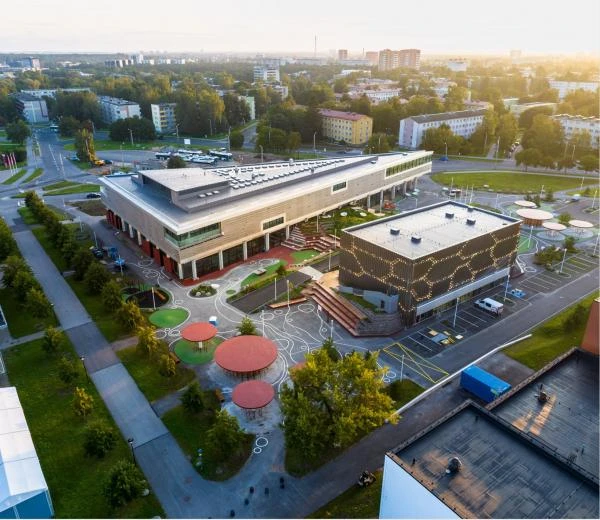
"We may imagine that building with wood means erecting houses from solid logs, but figuratively speaking, not a single log stands upright on its own good faith, and timber buildings also use steel, concrete, technical systems, all sorts of fasteners, reinforcement, etc.," said Kertsmik, who measured the footprint of MURG and PERG based on Estonia's first carbon footprint methodology and material database. When calculating the footprint of the gymnasiums, it became clear that the difference is minimal – Pelgulinn State Gymnasium's emissions are only two kilograms of CO2 equivalent smaller (per square meter per year).
Wood has enormous potential, but currently concrete is outshining it
One reason is the cross-laminated timber, or CLT, used for building timber buildings, which is a highly processed building product. "In principle, we can say that currently in Estonia, building with concrete is even more environmentally friendly – our concrete producers have advanced greatly and optimized their production processes to compete in the Scandinavian market. Timber industry companies have not yet engaged with this to such a large extent," Kertsmik pointed out as one reason.
Additionally, she gave the example that Europe's bitumen carbon footprint has decreased threefold over ten years purely because its production has also been optimized. "We are not just talking about renewable material here, the optimization of processes naturally also has an effect," she clarified.
Alvin Järving emphasized that when measuring footprint, it is also important to consider the building's adaptability and the possibility of changing its function over a longer period. For example, Mustamäe State Gymnasium is designed in such a way that its frame system's interior can be quite easily changed in the future. Architect Must has also experimented with introducing different functions into the building and found that the school can be quite easily converted, if necessary, into, for example, a spa hotel. Such approaches do not yet have an impact in footprint calculation methods, but could be one component in, for example, lifecycle footprint calculations for buildings with a lifespan longer than 50 years.
"A building designed according to multiple scenarios has a smaller footprint also due to a longer operating period, because thanks to this, there is no need to demolish the building after 50 years when it has lost its original function, as unfortunately happened with the old finance ministry building, which had too-low ceilings and too many load-bearing walls – it was impossible to redesign the building for a new function. However, engineering wisdom to account for future solutions significantly extends the lifespan of every building," added Alvin Järving.
"Wood has enormous potential to become a carbon-neutral building material, but for this the industry needs to make another leap in its production; at the current moment, concrete also outshines cross-laminated timber thanks to its recycling potential," summed up Kertsmik.
The Estonian Association of Architects' climate seminar series "Who is the architect of climate?" is organized within the framework of the association's research project SUrF. The first seminar took place in April and the next will take place on May 30. The event is supported by the Estonian Cultural Endowment.
Search
Keywords
Most read articles
- Price per Square Meter of Apartments in Tallinn in 2025

- Apartment Market in Early 2026: Prices Rising, Transaction Activity Remains Modest

- Apartment Market in Early 2026: Prices Rise, Transaction Activity Remains Modest
- Estonian Apartment Prices and Market Expectations in 2025
- Notary Fee and State Fee – Who Pays and How Much?