Interior Design Experts on Trends, Innovations, Pets, and Art
Interior design experts on trends, developments, pets, and art
Kaanon Real Estate spoke with long-time interior designers Miina Kraav (Omaruum OÜ) and Ulvi Raudsik (Eluviis OÜ) about, among other things, interior design trends, budgeting, the selection of Estonian shops, the importance of art, and the impact of pets. Happy reading!
Interior design is a process that makes many people's eyes light up. For this reason, we decided to create a small series in which we talk to experts in our field about various interior design-related topics. This story is the third in the series. Familiarize yourself with the previous stories in the series:
- Interior design expert gives advice and reveals principles
- Interior design expert gives advice and principles #2
How much do you take into account your client's suggestions? If a wish seems absurd to you, do you try to convince the client otherwise, and how?
Miina: Generally, a picture says more than a thousand words. If time and budget allow even slightly, I often draw through different variations both from the client's perspective and my own. A 3D image is what helps in this case.
Ulvi: I once had an interesting experience with a project where they said the wish was to get a toilet under the sloped roof, and they added that it would be used by a short homeowner, so I should boldly put the toilet under the sloped ceiling. I did make explanatory drawings where a man stood in front of the toilet with his height marked, and I warned that the brother-in-law certainly wouldn't be able to use it properly. But they countered that it was unnecessary worry, the brother-in-law would never use this room anyway. But when the bathroom was finished and the daughter's husband started using the toilet, all the frustration landed on my head. The client claimed that he did look at the drawings, but didn't understand anything. If there is a lack of trust and willingness to listen on the client's part, then visualizations won't help either. If now some client stubbornly wants something that doesn't work, I'd rather end the project before work begins. There's not such a huge shortage of work that I have to sign off on all kinds of nonsense.
That was a functionality problem, but if something just seems ugly to you?
M: That hasn't happened very often, usually the client trusts. When materials and colors are placed next to each other, color differences are generally noticed and people understand what works and what doesn't.
How many clients tell you that you're the interior designer, you know things better, and I won't interfere? How many stubborn ones are there whose opinion is that the customer is always king?
M: Most are somewhere in between. A few times you have to talk more with the person and explain. That if we put X thing there, then this happens. Sometimes the person themselves isn't quite sure what they want functionally.
U: It gets complicated when you want multifunctional spaces. For example, we designed a very nice grilling house and the client wanted to add a lot of functions to it. But in the end, the client had to admit that an interior designer/architect is not a magician. If you have square meters in front of you, you can only fit a limited number of functions in there.
M: Sometimes a client comes who says they don't want to see any wallpaper and wants to cover all floors with stone. And then you start convincing them… If you explain well why some choice is better, then the person thinks a bit and usually ends up understanding.
U: Our job is also to talk a lot about architecture and make people notice a specific building with an architecture-friendly eye. To tell, for example, that funk is not really an organic solution in a historic house and vice versa. Sometimes you just need a very small push and direction of attention for things to fall into place.
What are this season's trends in interior design?
M: In interior design, a season is at least four or five years long. In any case, colors that had completely disappeared are starting to quietly return to interiors.
Still, such generalizations are very difficult; every space is intuitive. Trend equals personality.
U: When creating an interior, you need to understand the expectations of the person moving in regarding the functionality and atmosphere of the spaces, try to understand what is natural to them. And then create an environment in their style so they feel as comfortable as possible there. These choices are beyond trends.
The ideal is when visiting friends say that the home is exactly your face. The goal is to find contact points that will harmonize with the surroundings.
M: But by the ceramic tile format, you can more or less tell when the house was built. Trends are perhaps most reflected in the finishing of sanitary rooms.
How is the budget created between the interior designer and the client?
M: Budget compilation is not something where you just look, think a bit, and write it down. In Estonia, it's not common for an interior architect to compile the budget themselves. But a budget would certainly help our work properly. Then the various impulse purchases of private clients during finishing work would disappear. I believe that in 10 years, it may become the norm for a budget to be considered a normal part of an interior architecture project.
U: Clients often feel embarrassed to talk about money. I understand that this is not a very artistic approach, but in order to avoid all sorts of disappointments, you still need to make an Excel table. You need to understand exactly how large the financial capacity is and what needs to be taken into account when planning different areas.
Why are so many new developments in Estonia similar on the inside?
U: Because some solutions are more optimal than others. The developer sees that they can get an optimally priced, highly marketable solution. I understand the developer very well. They have loans taken on the developments, the interest is to sell the object as quickly as possible, please as wide a range of buyers as possible, and do everything with as little energy consumption as possible.
The thing starts with the architectural project. An architect has a certain time specified in the contract to create a specific project. Since the pace of life is fast, the architectural composition of developments is mostly done in a hurry. An architect is a person; they have other work too; they may not be able to dedicate themselves to this specific object or squeeze the last bit out of themselves and this project.
M: For example, there was one architect we once worked with. We complained a bit at him for why he made such a boring house? "Well, there was little time, the client didn't pay much – so what am I going to strain myself to the limit?" he said.
The pressure is quite large from all sides, both for the developer and the architect. Presumably, the issue of risk tolerance is also relevant: things are done that are safe bets. To capture the average consumer, you need to create an average thing. The more neutral the solution is, the easier it is to manage the property and also rent it out further. Then it's a safe bet and apartments are already sold off according to the plan.
U: Often clients are also conservative. A client comes and tells the architect that look, I want a house. And then the architect makes a couple of rough sketches for the client and says, I would do it like this. Clients fear standing out and bury a somewhat bolder idea already in advance.
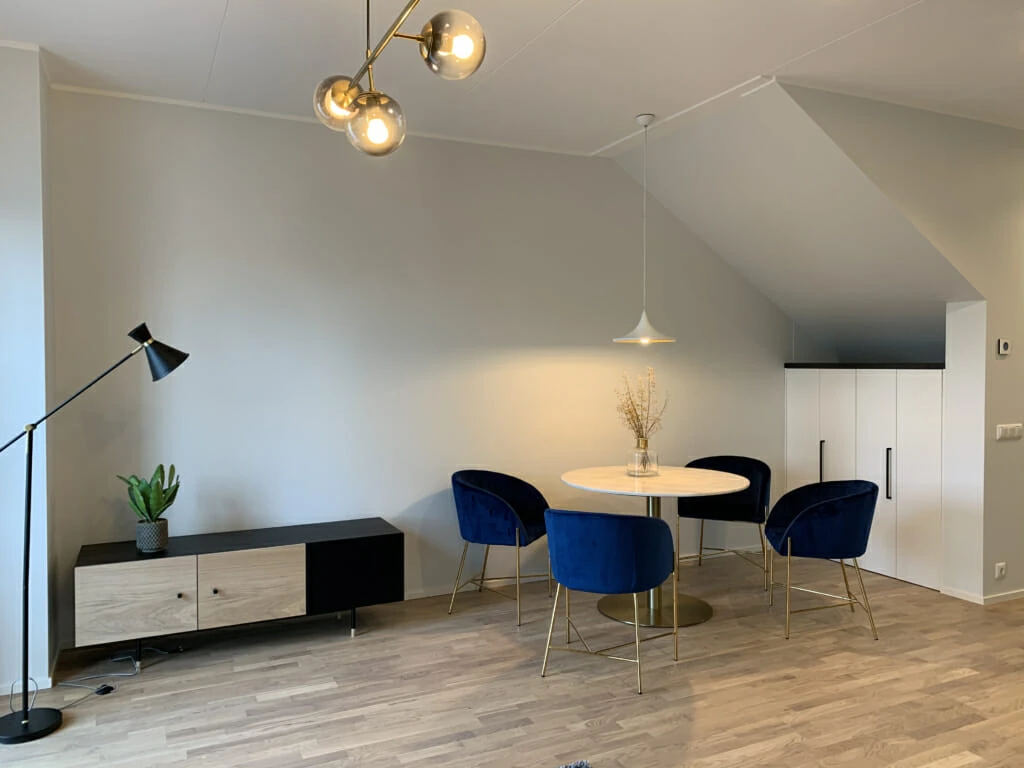
M: Also: often, for these rental-smelling new developments, an interior architect/designer is not bothered to be hired. From an interior design perspective, investment goes more to spaces that are located in very expensive building areas: city center, special seaside apartments, scenic places.
U: If it's a large middle-class development, it's thought that investing in interior design doesn't pay off. Although it must be said that recently, very beautiful developments have risen in Tallinn where people understand somewhat more that tastefully and completely designed spaces are also in a completely different price class.
How important is it really to involve a (good) interior architect?
U: There are people who think they are competent architects themselves. I'll do the project myself, and I'll only take an architect so they can format my work.
M: We sometimes get inquiries where the person has drawn something ugly themselves. 300–400 thousand euros is spent on the house, but an architect is not bothered to be involved. This is incomprehensible; this is a matter of overall cultural level.
Is the selection of shops available in Estonia sufficient for both your work and generally for achieving a tasteful interior design solution?
U: Generally yes. The range of Estonian shops is quite clear to us, since we have to make choices there on a daily basis. So if one wants something more special (spectacular lighting fixtures, furniture, accessories), then you have to look outside, for example in the direction of the USA. But if a client says that "let's try to get by with what we can find in Estonia, because I also want, for example, a warranty," then we say, "well, what can you do, we'll manage."
How do clients relate to art?
U: We're waiting for the time when the client considers it self-evident that art is part of the interior. I understand that people are very tired at the end of developments and projects and think that they could finally move in and get back to a normal life rhythm. We always try to tell the client that I will help you find art pieces, paintings, and frames for free so that the i's are finally dotted. But often the response is, "listen, we'll deal with that in half a year." And so this (important) topic just stalls.
M: Interiors without art are anonymous; they are not natural. Living without art is unthinkable; your home is then like a catalog house.
What impact do pets have on interior design and their possible presence?
M: Of course, the presence of a pet affects interior architectural and design decisions! First, there must be a specific place for the pet. Or at least there could be. Material selection also involves some work when a pet is present (for example, sofas and cats, wooden floors and large dog claws). Also, appropriate keywords include, for example, doors with pet doors.
U: One interesting example. One client has a large living room where open spaces tend to echo. But a carpet is a good sound dampener, and carpets would theoretically fit there very well. So the client was offered different carpet solutions, and the client said no, no carpet. Why? Because they have an entire garage full of carpets that the dogs have destroyed 1:0. There's nothing to do here; the carpets must be sacrificed for the dear pet and other solutions must be found to smooth out the room's acoustics.
Source: Kaanon Real Estate
Search
Keywords
Most read articles
- Price per Square Meter of Apartments in Tallinn in 2025

- Apartment Market in Early 2026: Prices Rising, Transaction Activity Remains Modest
- Apartment Market in Early 2026: Prices Rise, Transaction Activity Remains Modest
- Estonian Apartment Prices and Market Expectations in 2025
- Notary Fee and State Fee – Who Pays and How Much?