Haapsalu City Government's New Building to Be Built from Wood
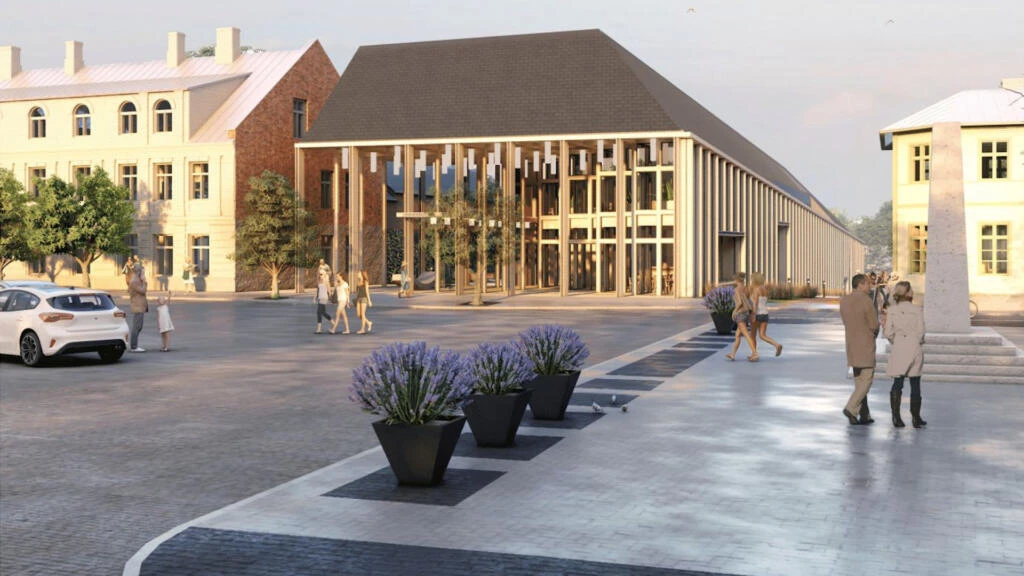
Haapsalu City Government organized an architecture competition in cooperation with the Estonian Architects Association, seeking a comprehensive solution for a new city government building. From a record number of design proposals submitted to the competition, the work titled "Cherry Garden" by architecture bureau molumba was recognized as the best. An exhibition of the competition works is open at Haapsalu Cultural Centre until the end of the month.
The architecture competition for a new Haapsalu City Government building, initiated in October of last year, received an unprecedented number of competition entries – a total of 36 design proposals were submitted by the deadline. "The jury's work was very intense and contentious, as there were many strong works. Overall, I am satisfied with the result, as it is possible to build from the winning work a building suitable for Haapsalu Lossiplats and the city government, one that will also beautify the urban space," commented Haapsalu Mayor and Jury Chairman Urmas Sukles.
According to jury member, architect Mattias Agabuš, the winning work offers a solution for a contemporary new city government building suitable for Haapsalu. "The proposed architectural approach is pleasant and contemporary, and the chosen timber architecture method appeals in many ways. The competition work contains witty allusions to medieval Haapsalu and historical carpentry. On the other hand, contemporary timber architecture appropriately helps reduce the carbon footprint of buildings – a direction in which Haapsalu wishes to participate through action," commented Agabuš, who believes that the "Cherry Garden" solution deserves the opportunity to contribute to enriching the spatial culture of Haapsalu and Estonia in general.
According to the vision of architecture bureau molumba, the new Haapsalu City Government building is both a refreshing and modest addition to the dignified historical town environment. The building's appearance is based on the building typologies established in Haapsalu's old town, adding a contemporary approach to them.
The new city government building creates a unified urban block and visual continuity with the current police building located at Lossiplats 4. Between the city government building and the police building, an intimate courtyard is created, which is designed as a pleasant cherry garden. The cherry garden, in the manner of a Japanese garden, is a strictly laid out yet intimate space with seating areas, where one can have both a picnic and a meeting. A stepped structure forms along the northern edge of the cherry garden, where the garden expands to Väike-Mere and Rüütli streets, where a pleasant public seating area and a well-maintained corner park form beneath an existing oak tree.
On the southern side of the building, there is a spacious covered sunlit area, an extension of Lossi Square and an outdoor space – or the building's formal main entrance. A logical extension of the square is created, or a kind of covered plaza, where a visitor can park a bicycle and where a café can expand during the summer season.
Väike-Mere Street becomes a typically Haapsalu-like narrow pedestrian street lined with buildings, where between the new building and the paved street a sufficiently wide green strip of shrubs and meadow grass can be created, creating low vegetation that promotes species diversity.
The building's architecture is consistent with Haapsalu's old town building style, forming a two-story house with a hip roof, the height of which decreases as Väike-Mere Street descends, thus giving the building a somewhat unexpected form and an interesting interior space on the second floor. While the basement floor exterior walls will be constructed from monolithic reinforced concrete, the city government's above-ground section is planned to be built with timber frames: cross-laminated timber floors and load-bearing walls, glued laminated timber posts, beams, and rafters. The building's exterior finish is also predominantly timber.
The roof opening toward the courtyard on the western side, not visible from ground level, will be covered with solar panels. The building follows all principles for achieving good energy efficiency, and the architectural solution helps achieve near-zero energy levels.
Currently, the city government operates in an administrative building completed in 1972 on Posti Street, and the existing building no longer meets the city government's needs.
In total, the architecture competition prize fund amounted to 38,000 euros.
First Prize (13,000 euros) went to the authors of "Cherry Garden": Karli Luik, Johan Tali, and Harri Kaplan (molumba)
Second Prize (10,000 euros) was awarded to architecture bureau DAGOpen for the design proposal "City House", authors: Jaan Kuusemets, Keiu Tulev, Erko Luhaaru, Allar Esko, Anna Solts, Angelina Šilova, and Ervin Golvih.
Third Prize (7,000 euros) was won by Siiri Vallner and Indrek Peil from architecture bureau KAVAKAVA for the design proposal "Lasse and Bosse".
Encouragement prizes (both 4,000 euros) were decided to be awarded to the authors of the design proposals "Vista" and "Quartet", who turned out to be Eero Endjärv and Kaarel Susi from architecture bureau Architect 11, as well as from architecture bureaus Asum Architects, Kuup Ruut, and Sala Terrena architects Hannes Koppel, Rahi Herm Lokotar, Karl-Johan Jakobson, Tristen Vardja, Eneli Niinepuu, and Grete Loviis-Saar.
The architecture competition jury included Haapsalu Mayor and Jury Chairman Urmas Sukles, Haapsalu Deputy Mayor Helen Rammu, Haapsalu architect-planner Maarja Toomemäe, authorized architect Harry Lindemann, and Estonian Architects Association members authorized architects Mattias Agabuš, Vahur Sova, and Maarja Elm-Sadam.
An exhibition of the competition works is open at Haapsalu Cultural Centre until the end of the month.
Search
Keywords
Most read articles
- Price per Square Meter of Apartments in Tallinn in 2025
- Apartment Market in Early 2026: Prices Rising, Transaction Activity Remains Modest
- Apartment Market in Early 2026: Prices Rise, Transaction Activity Remains Modest
- Estonian Apartment Prices and Market Expectations in 2025
- Notary Fee and State Fee – Who Pays and How Much?