Experiment: What Children Actually Use on Playgrounds
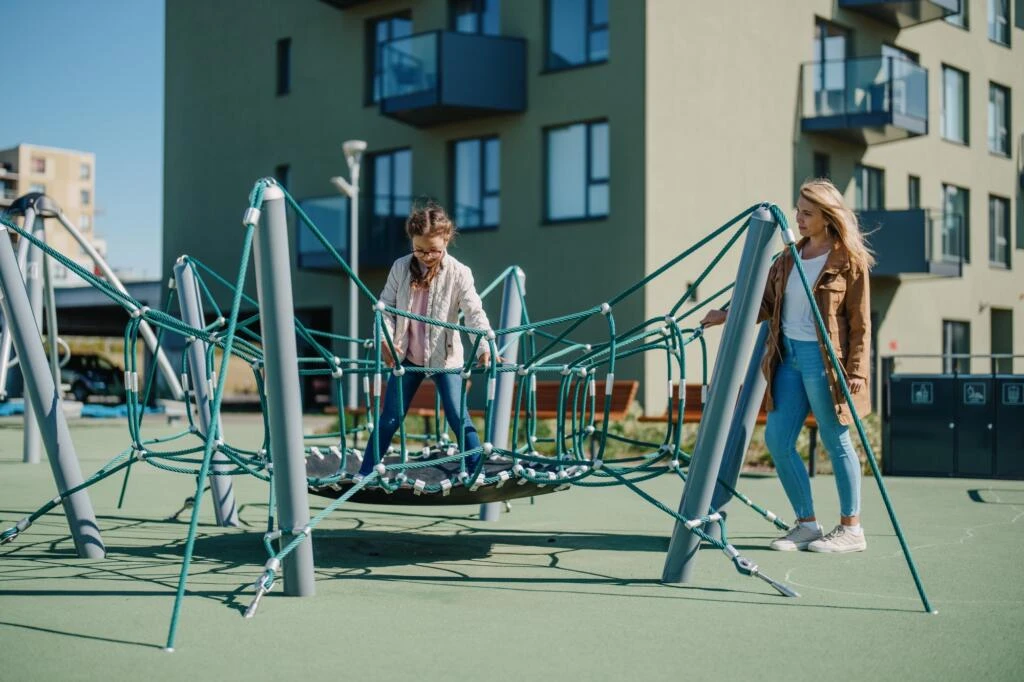
Housing development company Bonava conducted an experiment where children got to test various playgrounds in the capital's semi-open courtyards and provide feedback on what they think of the attractions. According to the action's leader, Bonava landscape architect Eda Vane, the goal was to get direct input from the target group to improve courtyard areas, where activities aimed at children are always an important part.
It turned out that the most engaging playgrounds are those that offer opportunities for joint activities and games with friends or parents, and where adults have also been considered.
Adult expertise vs children's expertise
Bonava has an in-house project team that deals with product development on a daily basis. Since figuratively speaking, the design, construction, and sales and customer service departments are all at the same table, homes are created at every stage in close cooperation and continuously taking into account feedback from homebuyers. In this way, as a result of synergy between different experts, it is possible to continuously improve the solutions offered.
One such example is also the planning of courtyards for future homes, an important part of which is activities aimed at children. In order to take into account, in addition to the expertise of adults, also the expectations of the real target group, namely children, Bonava conducted a playground study.
Specifically, families were invited to visit larger semi-open playgrounds in apartment building courtyards. The experiment involved 12 families with children aged 2-12, who visited 17 playgrounds over the course of a month. A total of 33 playground visits were made, for which feedback questionnaires were completed.
Creativity and joint activities for every age
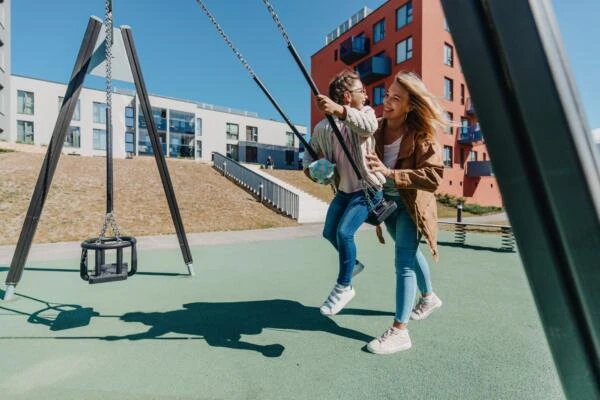
As conclusions, it emerged that often playgrounds do not encourage cooperation with family or friends and are created in an environment where, to ensure safety, it is necessary to limit the play area with a separate fence. Playgrounds that receive approval from families are those with multifunctional training equipment and elements created for children that encourage creative use or joint activities: carousels, swings and baby swings.
More specifically, from the experiment results it can be seen that children up to five years old prefer sandboxes, swings, simpler lower climbing structures with slides and attractions suitable for role-play and free play: playhouse, blackboard, table and chairs.
Older children, over five years old, choose attractions that present more physical challenge for play: adventure trails, climbing walls, skate parks, street training equipment. If there is something to spend time on with friends in the selection, that is preferred: a nest swing, a ball court, board games, such as table tennis and table football.
"Attractions that don't captivate children are often too simple, boring, don't present a challenge or inspire creativity. Or they are a disappointment for younger children as they are out of reach. There are many such play equipment where you can only play on your own, which is why children lose interest in playing much faster. Parents themselves, however, appreciate it when the playground has also been designed for adults and the maintenance of the surroundings, for example, there are benches, rest areas and trash cans," sums up landscape architect Eda Vane the findings of the playground study.
It is smart for housing developers and experts planning courtyards to collect feedback from direct users of their product. This way it is possible to get confirmation that the solutions made actually work or to see opportunities for how to improve something. This is especially true when planning products and activities aimed at children, where an adult's imagination may differ from what children actually prefer.
The results of the playground use experiment encourage creating more opportunities for cooperation and spending time together in courtyards, both in the form of play attractions and activities and leisure opportunities aimed at adults. In addition, to ensure that in courtyards close to home there continue to be attractions that take into account the interests and creativity of children of different ages and that it is a safe environment where children really have fun.
Search
Keywords
Most read articles
- Price per Square Meter of Apartments in Tallinn in 2025

- Apartment Market in Early 2026: Prices Rising, Transaction Activity Remains Modest
- Apartment Market in Early 2026: Prices Rise, Transaction Activity Remains Modest
- Estonian Apartment Prices and Market Expectations in 2025
- Notary Fee and State Fee – Who Pays and How Much?