Construction Work on Estonia's Largest Wooden Building Has Begun
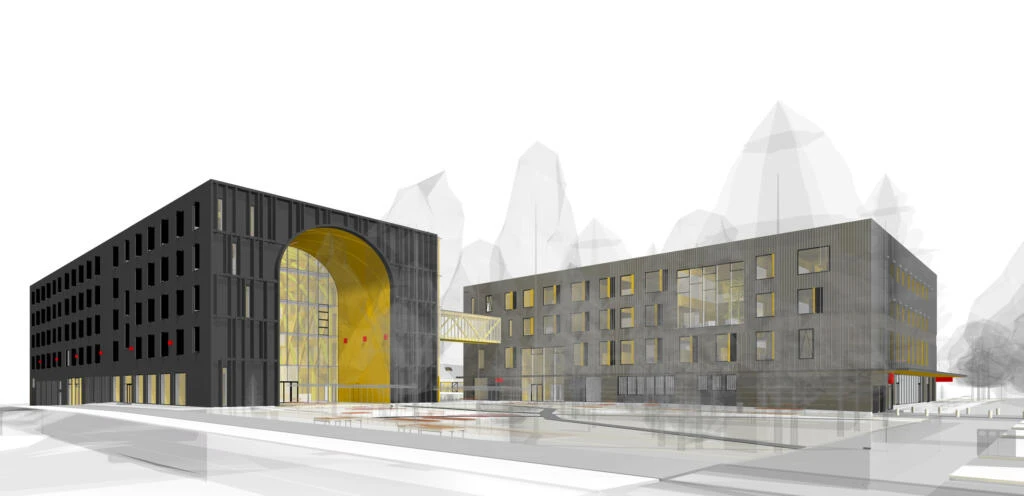
Construction work has begun on the Natural History Museum on Tallinn's fastest-developing seaside promenade. According to the main contract signed in December 2023, Nordecon AS is responsible for the construction work of the Natural History Museum on behalf of the State Real Estate AS. Estonia's largest wooden building will be constructed in Tallinn's Kalamaja district, immediately next to the Seaplane Harbour, and in 2.5 years its largest user will be the Estonian Natural History Museum.
Excavation work for the foundation pit required for the building complex has begun at the construction site. The Natural History Museum consists of three separate buildings that are connected underground. The total heights of the very different buildings in the complex extend more than 20 meters above ground level. The museum building with a triangular floor plan has a roof with a steep slope and the total height difference of this building is 10 meters. According to the project, the building complex is designed to have 1 underground floor.
"The first phase of work during the winter period is mainly related to excavation work, and from there towards spring, construction of the foundation and underground floor will follow. The greater spectacle of the construction work, when the buildings start to rise in height, will remain in the second half of the year and into the next year," commented Rauno Rausk, project manager at Nordecon.
Traffic management during construction has been resolved in accordance with the site's traffic scheme. Given the site's location in close proximity to Kalaranna Road, which has heavy traffic, the movement of construction transport may temporarily cause traffic management at the turn-around point on Vesilennuki Road to differ from normal. During the excavation work, many trucks will also be moving in the area, so road users are asked to observe temporary signs for safety reasons.
"We ask the local community for patience and understanding, as every construction process inevitably brings some inconveniences to its surroundings due to increased noise levels or dust in the air. We will do our best to manage these in accordance with all requirements as well as possible," explained Rausk.
The completed Natural History Museum will house new and modern facilities for the Environmental Board, Environmental Agency, Environmental Investments Centre, Ministry IT Centre, and (planned) Land and Spatial Planning Agency. The building's largest user, however, will be the Estonian Natural History Museum.
The closed net area of the Natural History Museum is planned to be 24,660 m2. The Natural History Museum is located at Vesilennuki 12, Tallinn. It will be Estonia's largest wooden building in public use. Currently, the largest wooden building is the recently completed Pelgulinn State Gymnasium in Tallinn. The Natural History Museum's public architectural competition was won by the architectural bureau Kavakava OÜ, architects Siiri Vallner, Indrek Peil, Kristel Niisuke and Ko Ai. The planned completion time for the building is summer 2026.
Search
Keywords
Most read articles
- Price per Square Meter of Apartments in Tallinn in 2025

- Apartment Market in Early 2026: Prices Rising, Transaction Activity Remains Modest

- Apartment Market in Early 2026: Prices Rise, Transaction Activity Remains Modest
- Estonian Apartment Prices and Market Expectations in 2025

- Notary Fee and State Fee – Who Pays and How Much?