Can a Well-Located Home Replace a Second Car?
Have you ever thought about how much a second car for the family actually costs? Usually, people calculate the purchase price or leasing payment, but the monthly expenses also include insurance, fuel, maintenance, tires, parking, and much more. In total, this can mean hundreds of euros per month even if the car is only used for a few short trips per day.
At the same time, often a single well-considered decision is enough to significantly reduce this expense. If your home is located in a place where you can comfortably reach work, school, kindergarten, or shops by bicycle, a second car may turn out to be completely unnecessary. A one-time investment in a quality bike pays for itself over time, and in addition to the financial gain, daily commuting becomes easier and healthier. Therefore, when buying a home, it's worth looking not only at parking spaces but also at what opportunities the surroundings offer for cycling.
The 10-minute rule helps determine whether a second car is needed at all
When choosing a home, attention is paid to public transport, roads, and parking options. However, more and more families are adding another question to this list: can you do your daily trips by bicycle from here?
A good guideline can be the so-called 10-minute rule. If you can reach work, school, kindergarten, or a larger grocery store by bike from home in about ten minutes, a second car becomes a convenience rather than a necessity in many families. This doesn't mean you should give up a car entirely, but often one family car is completely sufficient.
A well-functioning network of cycling paths plays an important role here. Safe and logical connections make cycling convenient for both adults and children. Therefore, quality cycling infrastructure can be an important part of a home's value, just like a nearby school, shop, or park. The easier it is to do daily trips without a car, the lower your family's fixed costs and the more flexible your everyday life becomes.
Which bike suits which home?
Not all bikes are created for the same use, and the location of your home also affects which model works best.
If you live in a city apartment or a densely populated area where shops, schools, and services are nearby, a practical and particularly convenient choice is electric city bikes. An upright riding position makes commuting comfortable, and fenders, a cargo rack, and a basket help you do everyday shopping or commute to work without having to carry additional equipment. You get on an electric city bike the same way you get into a car – you just ride.
If your home is located a bit further from the center or you frequently travel to neighboring municipalities, it's worth looking at the electric bikes category. An electric motor assists the rider up to 25 km/h, which means longer distances are covered faster and with less physical strain. Headwinds or gentle climbs no longer become obstacles, and when you arrive at work, you don't have to worry about arriving sweaty. This is precisely why electric bikes have become a real alternative to a second car for many families.
If forest paths, gravel roads, or nature trails begin around your home, then mountain bikes offer the most possibilities. These are not only suitable for sports training but also for everyday travel in places where asphalt doesn't lead everywhere. Wider tires and a sturdy frame make riding more stable even in changing road conditions, and studded tires help extend the cycling season even during winter.
Many today also choose a gravel bike or gravel bicycle, which is characterized by drop bars. This is well-suited for those whose daily routes combine both asphalt and gravel sections and who want as versatile use as possible with a single bike.
What should you check at home before buying?
Once you've found a suitable home, it's worth taking a moment to think about where your bicycle will actually live. Safe bike storage is just as important as a car parking spot.
Is there a bike room, cellar, or locked storage space in the building? Can the bike be easily taken in and out if needed without narrow stairs or complicated doors? The easier it is to use the bike daily, the more likely it will actually be used rather than gathering dust.
For electric bikes, you should also pay attention to charging options. Convenient access to electricity helps charge the battery safely and avoids situations where the bike needs to be carried up or down multiple floors each time.
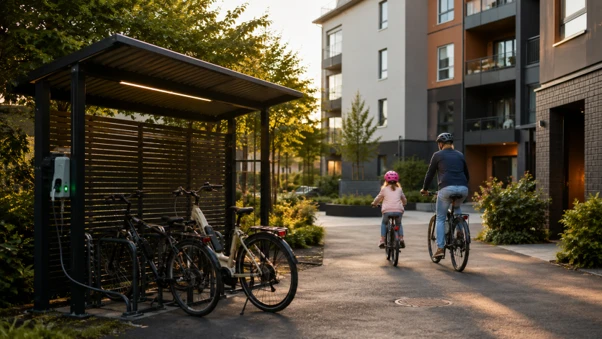
In newer apartment buildings, you increasingly encounter special bike houses or well-thought-out bike rooms. These show that developers take changing commuting habits into account and understand that a bicycle is no longer just a leisure-time vehicle, but for many people an everyday mode of transportation.
When buying a home, it's therefore worth evaluating not only the number of parking spaces, but also how conveniently you can use a bicycle. This can affect your everyday quality of life more than it first appears.
Before buying a second car, work through your family's daily trips
A second car often seems like the natural next step when a family grows or daily trips increase. In reality, before purchasing a new car, it's worth taking a moment and honestly reviewing your commuting habits.
If most of your trips are within a few kilometers and your routes run along safe cycling paths, a well-chosen home combined with a suitable bike can meet the same need with lower costs. This doesn't mean the car loses its place, but in many families, one car is completely sufficient if daily short trips are made by bike or bikes.
Therefore, when buying a home, it's worth looking at the property a bit more broadly. In addition to the number of rooms, layout, and parking spaces, think about how easily you can get around without starting a car. Sometimes the greatest value of a good home doesn't lie in how many cars fit in front of it, but rather in the fact that you no longer need to use one of them on a daily basis.
Search
Keywords
Most read articles
- Price per Square Meter of Apartments in Tallinn in 2025

- Apartment Market in Early 2026: Prices Rising, Transaction Activity Remains Modest
- Apartment Market in Early 2026: Prices Rise, Transaction Activity Remains Modest
- Estonian Apartment Prices and Market Expectations in 2025
- Notary Fee and State Fee – Who Pays and How Much?