The Role of Battery Banks in Electricity Grid Balancing Gets New Momentum
Estonia's disconnection from the Russian electricity grid (BRELL) in February 2025 and the transition to the Continental European frequency opens up more opportunities for renewable energy producers: to earn revenue through electricity grid balancing. This applies in particular to battery owners, whose equipment allows participation in intraday frequency regulation and market balancing.
The electricity grid must be stable, which means continuously maintaining balance between energy production and consumption. Every day, the electricity demand for the next day is forecast, and trading on the electricity exchange takes place according to the predicted volumes. If forecasts do not match reality exactly, private producers with battery solutions can participate in intraday trading, or in other words, the stabilization market.
Since disconnection from the Russian electricity grid will result in larger fluctuations, it is predicted that participation fees on the stabilization market will be higher than ordinary electricity sales, and this is an opportunity for private producers. The recent Estlink 2 connection cable rupture demonstrates the importance of private electricity production in ensuring energy security even more.
Developing energy management has created a need for smart solutions that can communicate independently with the electricity grid. This in turn has sparked a race among energy equipment providers to simplify consumer life.
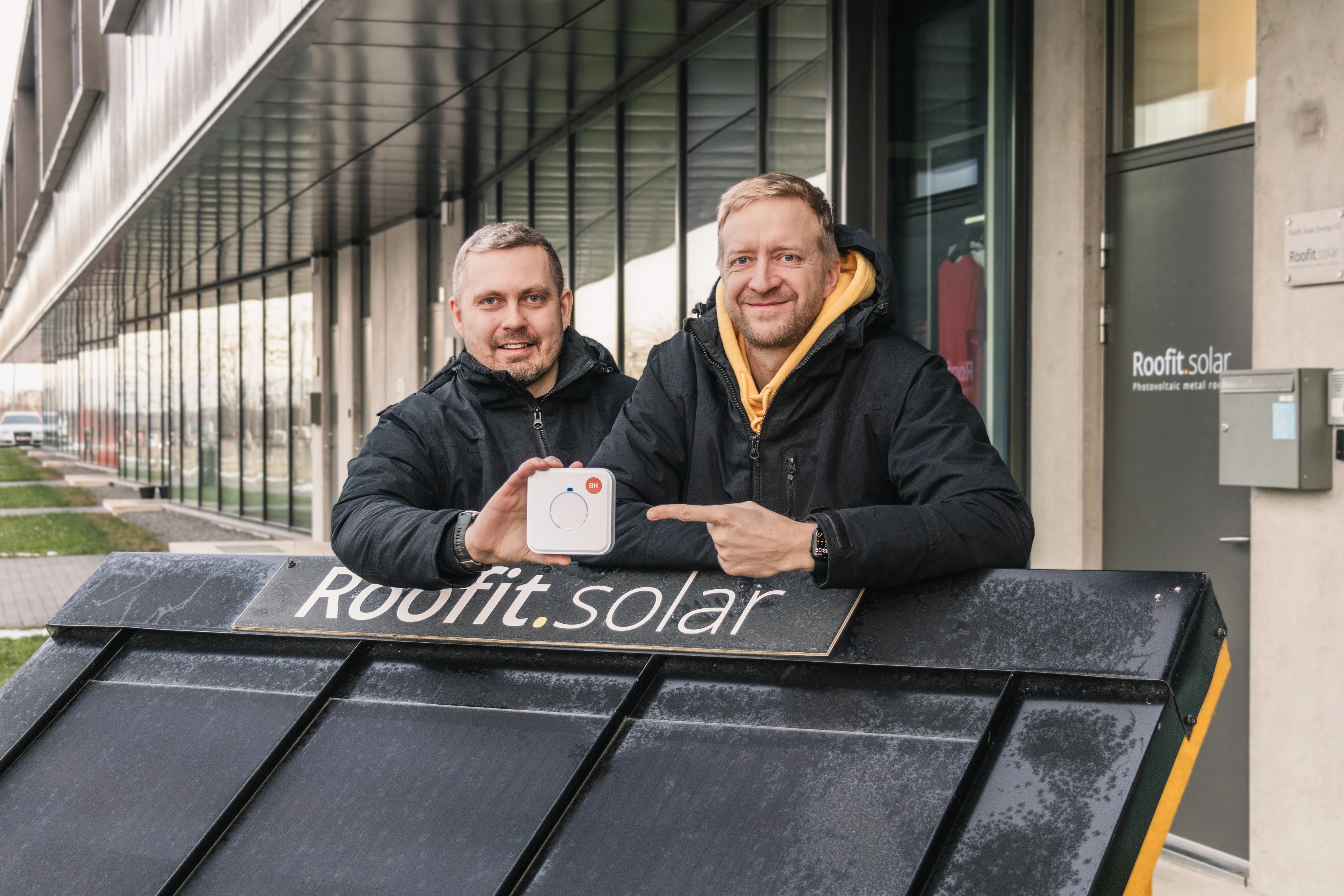
As an example, we can mention Estonia's leading solar roof producer Roofit.Solar, which launched its energy management service BrightHour today, which has two main functions. First, AI-based battery management that purchases electrical energy when it is cheap and sells it to the grid when the price is high. Second, participation in the grid stabilization market (FLEX service), which exports electricity to the grid in situations where the grid frequency is lacking. With the help of artificial intelligence, the system decides by itself when it is most reasonable to do this.
"While currently many private producers still manually control electricity sales to the grid, such innovative smart devices digitalize this activity. Thus, combining renewable energy and smart technology can offer private consumers new revenue sources, contribute to energy security, and at the same time support the green transition," said Roofit.Solar CEO Andres Anijalg.
Adding similar devices to the battery inverter can also significantly shorten battery payback periods. For example, Anijalg earned 469 euros in a year from BrightHour battery management and another 284 euros from stabilization services. "This means that my 10 kWh battery payback period has been shortened significantly," shared Anijalg from his own experience.
Search
Keywords
Most read articles
- Price per Square Meter of Apartments in Tallinn in 2025

- Apartment Market in Early 2026: Prices Rising, Transaction Activity Remains Modest

- Apartment Market in Early 2026: Prices Rise, Transaction Activity Remains Modest
- Estonian Apartment Prices and Market Expectations in 2025
- Notary Fee and State Fee – Who Pays and How Much?