A-energy class home: what it really means for an apartment buyer

Does the letter A on an energy label automatically mean a smaller bill? Not quite. A-class indicates that a building's energy requirement under normal use is calculated to be very small. We'll explain what this really means for your monthly costs, indoor climate, and home loan.
Short answer: A-energy class means that a residential building's energy performance indicator (EPI) falls into the best class on the current scale. All buildings that received a building permit from 2020 onwards must be nearly zero-energy buildings, or A-class. For a buyer, compared to an old unrennovated building, this means significantly lower utility costs, heat recovery ventilation, and the opportunity to get a green home loan from a bank at a more favorable margin. However, the heating costs of A- and B-class buildings are often not particularly different when using district heating, so it's always worth asking about the solutions behind the energy label.
Topic | What A-class provides | What to ask as a buyer |
|---|---|---|
Costs | Low energy requirement under normal use | Heating source, solar panels, common area costs |
Indoor climate | Heat recovery ventilation, airtight building | Summer shading and cooling readiness |
Home loan | Green home loan available at many banks | Bank's EPI limits and application period |
Documents | Energy label in building register | Whether the label is based on calculation or measured consumption |
What the letter A on the energy label actually measures
The energy label class comes from the energy performance indicator, or EPI. According to the State Gazette, it is the weighted delivered energy use per unit area of a building under normal use, measured in kWh per square meter per year. The calculation includes room heating, heating of ventilation air, hot water preparation, electricity for fans and pumps, lighting, and household appliances.
The key word is normal use. The EPI is calculated using standard assumptions: a specific indoor air temperature, number of residents, and water consumption. It does not account for whether you prefer 24 degrees of warmth or shower twice a day. This way, the EPI compares buildings fairly with each other, but your actual bill also depends on your habits.
Previously, on the A-H scale that was in effect, an apartment building's A-class limit was EPI up to 105 kWh/(m²·a) and C-class limit was 150. Starting June 1, 2025, updated energy efficiency regulations apply, replacing the A-H scale with the EU's harmonized A-G scale. Since class limits have changed, always look at both the class and EPI number from a specific building's label.
Why the heating source affects the letter
Not all kilowatt-hours are equal in the EPI. Each energy carrier is multiplied by a weighting factor, which according to Estonia's climate minister's regulation is 2.0 for electricity, 0.9 for district heating, 0.65 for efficient district heating and wood and other biofuels, and 1.0 for fossil fuels. This is why the choice of heating source directly affects how much insulation and solar panels are needed to reach A-class.
For the buyer, this means that two A-class buildings can be constructed very differently. One might get warmth from district heating, another from a ground source heat pump with solar power panels on the roof. Among Kinnisvara24's new developments are for example Al Mare Torn, where district heating is combined with ground heating and apartments have cooling ventilation units, and Grand Kvissental, whose A-class is achieved through, among other things, solar panels.
How much an A-class home saves monthly
Specific figures come from a 2024 comparison by TalTech professor Jarek Kurnitski, which looks at energy and maintenance costs per month for a 65 m² apartment. In an old unrennovated E-class building it was about 190 euros, in a renovated B-class building about 86 euros, and in a new B-class building with heated garage about 99 euros. The calculation used 95 €/MWh as the heat price and 200 €/MWh as the electricity price including VAT.
Let's do a simple calculation with these figures. If you moved from an old E-class apartment to a new energy-efficient 65 m² home, the difference would be about 90 euros per month or roughly 1,100 euros per year. Over ten years, this adds up to over 10,000 euros, without even accounting for rising energy prices. For example, according to ERR, district heating bills in January 2026 were about 50% higher than a year earlier, and the smaller your energy requirement, the less such jumps will shake your budget.
Kurnitski's comparison also highlights one lesser-known detail: in district heating buildings, the heating costs of A- and B-class are essentially no different, and A-class is cheaper mainly due to electricity. So don't dismiss a B-class building immediately if the location and layout suit you better. Rather, check whether the costs of common areas, such as a heated parking garage, won't eat up the savings.
Indoor climate: fresh air in winter and coolness in summer
According to the Consumer Protection and Technical Supervision Authority's energy label inspection guide, the basic solution for a nearly zero-energy apartment building includes heat recovery ventilation with at least 80% efficiency and approximately 250 mm of insulation on external walls. Heat recovery means that the warm exhaust air warms the incoming fresh air. This way, you get fresh air continuously in winter without drafts from an open window.
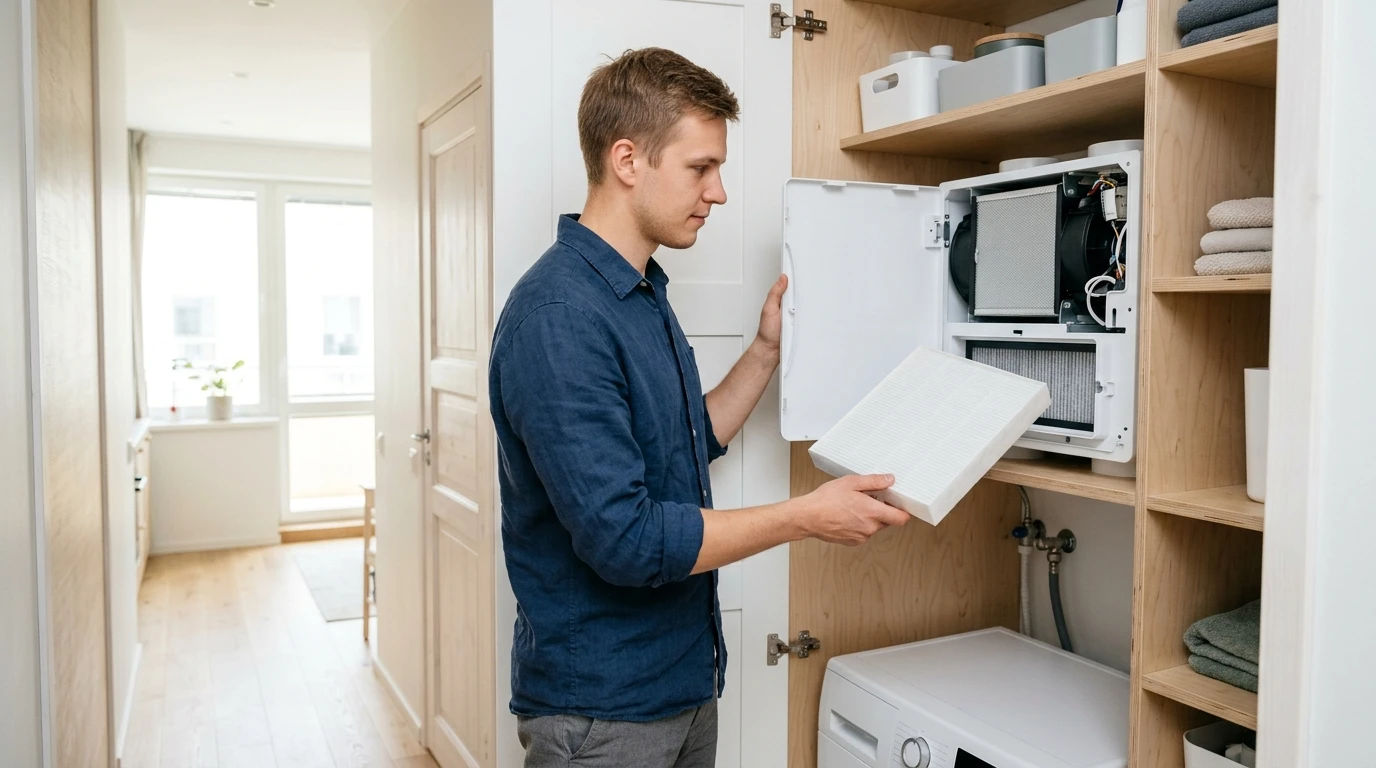
Such a system is built for continuous operation and requires maintenance. Regular filter replacement keeps airflows at the level intended in the design and the device's energy consumption low. Ask the developer at handover about the filter replacement schedule and the appropriate filter type, as this is routine maintenance for every A-class apartment owner.
A tight and well-insulated building keeps heat in well even in summer. Therefore, the building energy efficiency minimum requirements regulation requires that in residential buildings, room temperature must not exceed the cooling device setpoint by more than 150 degree-hours between June 1 and August 31. The residential setpoint is 27 °C. As a buyer, ask how this requirement is met: are windows shaded, does ventilation cool, or is there readiness for cooling installation in the apartment.
A-class and home loans
An energy-efficient home is a lower-risk collateral for banks, which is why several banks offer green home loans for A- and B-class properties. In autumn 2026, SEB asks for margin starting from 1.35% + Euribor for applications purchasing an A- or B-class home from October 1 to December 31. LHV offers margin starting from 1.49% + 6-month Euribor for purchasing a new A- or B-class home, and Swedbank starting from 1.69% + 6-month Euribor for an A-class home.
Note that banks have their own EPI limits, which may depend on the building's construction year. Swedbank has emphasized that energy class affects the loan price but is not decisive in loan decisions. The decision is still based on your income and payment ability.
Example: if you take a 200,000 euro loan and the green condition gives a 0.3 percentage point lower margin compared to the standard offer, you would pay approximately 600 euros less in interest in the first year. As the loan balance decreases, this amount decreases year by year. For a closer look at loan basics, read our article home loan – what you should know before making a decision.
Energy label at purchase time: what to check
A new building's energy label is based on calculation and is valid according to the Building Code for two years from the building's completion. After that, a building can be given a measured consumption-based label, which is valid for ten years. A measured label shows the building's actual energy use and is therefore particularly valuable information when buying on the secondary market.
The Building Code requires that every sales or rental advertisement contain energy label data, including the EPI or measured energy consumption value and class. You can also find the label in the building register, where the label issuer enters it electronically. Compare the class shown in the advertisement with the label in the register, especially if the building is still under construction.
TalTech checked 104 new apartment buildings' energy labels for compliance with the actual construction on behalf of the Consumer Protection and Technical Supervision Authority. The overall picture was better than expected and consumers were misled only in isolated cases, but careless errors were common. If a building is built with less efficient solutions than the label assumes, residents' energy bills may increase significantly.
A common mistake is to rely only on the A-letter in the brochure. Ask the developer what solutions the label assumes: heating source, ventilation heat recovery efficiency, and solar panel capacity. Also ask whether the building's air leakage is measured. According to the regulation, actual air leakage must not exceed the value used in calculations, and an independent expert must verify this by measurement if a default base value was not used in the calculation.
When A-class is not the main criterion
According to TalTech, new apartments typically have A- or B-labels and soon most will be A-class as projects that received building permits before 2020 are completed. If you're choosing a secondary market apartment instead, check if the building has been renovated. To receive support for apartment building energy efficiency improvements, a reconstructed building must reach at least C-class, and in Kurnitski's comparison, well-renovated B-class building costs were even lower than those of new B-class buildings.
So if a renovated apartment building is located in a more suitable area for you and the price is better, it can be a perfectly sensible choice. Kinnisvara24's real estate market statistics can also help in your decision, where you can see regional price levels and how they change.
What the new EU requirements mean from 2030
According to the European Union's updated Buildings Energy Performance Directive, all new buildings must be zero-emission buildings from January 1, 2030, and public sector buildings already from 2028. The average primary energy consumption of the residential stock must be reduced by at least 16% compared to 2020 by 2030 and by 20–22% by 2035. Member states had to transpose the directive by May 29, 2026.
For the buyer, this means that an A-class home purchased today is already close to future requirements. In older unrennovated buildings, renovation decisions from the residents' association board will likely come in the coming years. For a good overview of the label's role, our article why is the energy label important also provides useful insight.

Find your energy-efficient home
The A-letter on the label means low energy requirement, better indoor climate, and often a better loan deal, but the real value comes from the solutions behind it. Ask about the heating source, ventilation, and summer cooling, and check the label in the building register. Browse Kinnisvara24's selection of new developments or use real estate search, where you can filter offers by energy class as well.
Search
Keywords
Most read articles
- Price per Square Meter of Apartments in Tallinn in 2025

- Apartment Market in Early 2026: Prices Rising, Transaction Activity Remains Modest

- Apartment Market in Early 2026: Prices Rise, Transaction Activity Remains Modest
- Estonian Apartment Prices and Market Expectations in 2025
- Notary Fee and State Fee – Who Pays and How Much?